

Cellular Biology
What Is Oxidative Stress? Redox Signals, Damage and Measurement
Understand reactive oxygen species, antioxidant systems and redox signalling, including why one fluorescent assay cannot establish oxidative damage.
25 October 2026 · 4 min read · Novaryn Labs
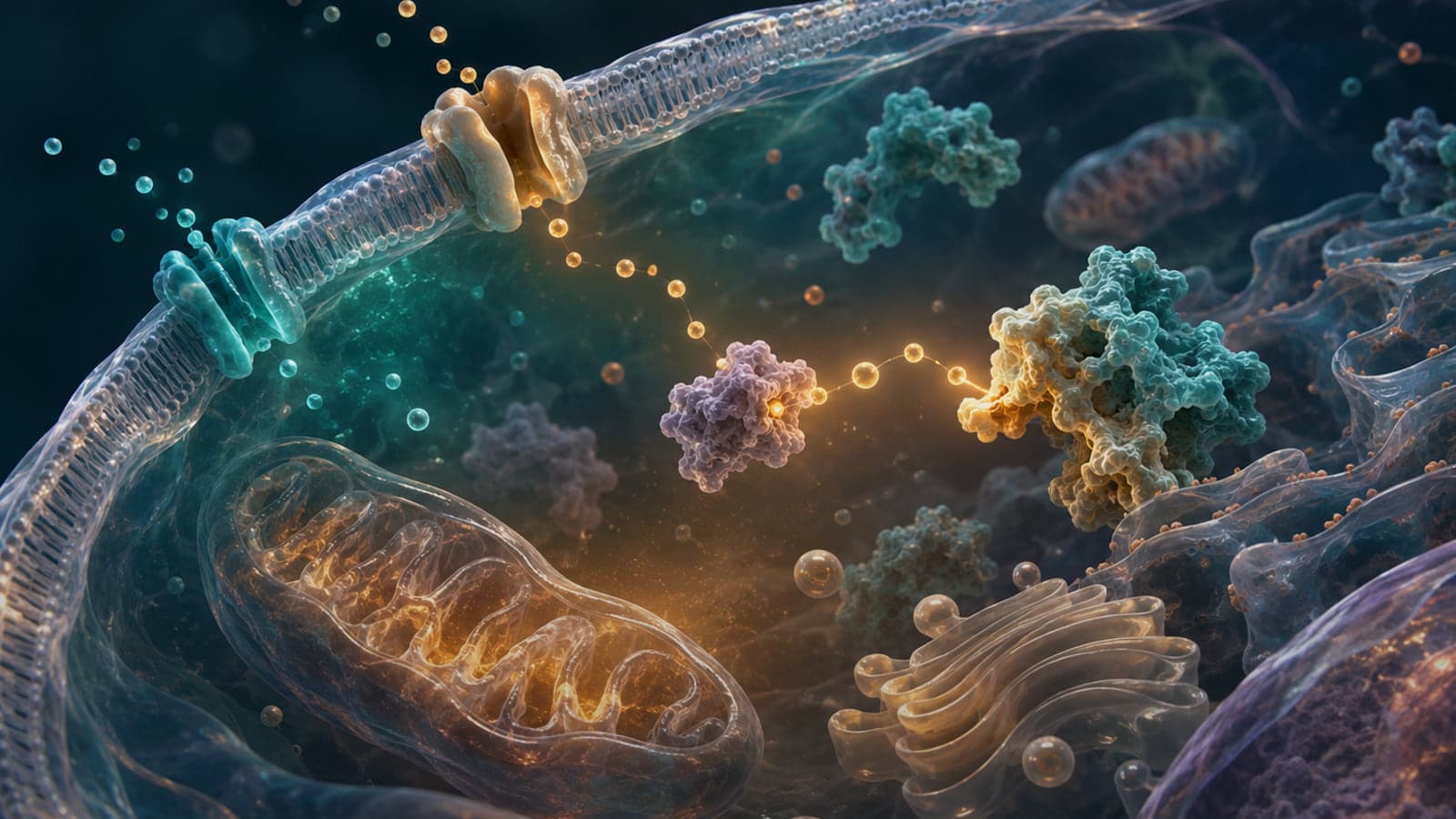
Oxidative stress describes a disturbance in redox balance that can disrupt signalling or damage cellular components. It is not simply the presence of oxygen-derived reactive molecules. Cells deliberately generate some of these molecules as signals and maintain systems that control where and when they act.
The distinction between regulated signalling and damaging oxidation is central to the field. Without it, an experiment can be reduced to an unhelpful story in which all oxidants are bad and every reduction in a probe signal is good.
Reactive oxygen species are chemically different
Reactive oxygen species, often grouped as ROS, include molecules with different lifetimes, reactivities and locations. Superoxide, hydrogen peroxide and highly reactive radicals should not be treated as one interchangeable substance.
Their sources also vary. Mitochondrial reactions can generate reactive species, but specialised enzymes such as NADPH oxidases produce signals in other cellular locations. The biological effect depends on the species, the target and the local environment.
A general statement that ROS increased therefore leaves several questions unanswered. Which species changed? In which compartment? For how long? Was the change accompanied by measurable damage or a regulated response?
Redox signalling can be precise
Proteins contain chemical groups that can undergo reversible oxidation, altering activity or interactions. Such changes can participate in signalling rather than representing permanent damage.
Sobotta and colleagues investigated a redox relay involving peroxiredoxin-2 and STAT3. Their experiments showed how a peroxide-sensitive protein could transmit an oxidative signal to a transcription factor. This is a concrete example of organised redox communication. Nature Chemical Biology, 2015.
The finding does not imply that all oxidation is beneficial. It shows why location and molecular mechanism matter. A controlled, reversible modification differs from widespread chemical injury to proteins, lipids or nucleic acids.
Defence systems regulate rather than erase chemistry
Cells use enzyme networks and small molecules to manage redox reactions. Superoxide dismutases, catalase, peroxiredoxins and glutathione-related systems participate in different parts of that network.
Glutathione can exist in reduced and oxidised forms, and its behaviour depends on synthesis, recycling, compartment and demand. Measuring one glutathione-related quantity does not reveal the entire redox state of a cell.
The term antioxidant is therefore contextual. A material can react with an oxidant in a cell-free assay without reaching the relevant site in a living cell. It may also affect signalling pathways or the assay itself. Chemical reactivity is a starting point for investigation, not a complete biological conclusion.
Oxidative damage requires suitable evidence
Researchers can examine modifications to lipids, proteins or DNA using appropriate analytical methods. These endpoints differ from general probe fluorescence. A change in a signalling-sensitive probe may occur without measurable damage, while damage can persist after a transient oxidant signal has passed.
Sample handling is especially important. Oxidation can occur during collection or processing, creating artefacts. Controls should distinguish changes that occurred in the biological system from changes introduced during measurement.
A convincing study links the proposed source, the relevant molecular change and the functional consequence. Removing or altering the suspected source can help test causality, but the intervention’s other effects must be considered.
Why fluorescent probes need caution
A widely used probe family based on DCFH responds through complex chemistry and is not a specific direct measure of hydrogen peroxide. Its signal can be influenced by local conditions and other reactive processes. The 2022 measurement guidelines explain these limitations.
This does not make every probe experiment worthless. It means the conclusion should match the method: an initial indication of altered redox-related conditions may justify further investigation. It should not be presented as a precise measurement of a particular ROS without validation.
Researchers can combine targeted probes, biochemical measurements and functional assays to reduce dependence on one readout. A compound that changes fluorescence directly must be distinguished from one that changes cellular biology.
Research applications and unresolved questions
Redox research contributes to studies of inflammation, mitochondrial signalling, ageing and tissue injury. The same pathway can support adaptation in one context and contribute to dysfunction in another.
Important questions concern spatial specificity, timing and the relationship between redox markers and meaningful function. A short-term reduction in one marker does not establish a long-term outcome. Nor does a high antioxidant capacity in a test tube predict the response of an intact organism.
Independent readers should ask whether a study measured a reactive species, a defence response, chemical damage or a functional endpoint. Keeping those categories separate makes the evidence substantially clearer.
Frequently asked questions
Are all ROS harmful?
No. Some participate in regulated signalling, while excessive or misplaced reactions can cause damage.
Is hydrogen peroxide a free radical?
No. It is a reactive oxygen species but does not have the unpaired electron that defines a free radical.
Does lower fluorescence prove less oxidative stress?
Not necessarily. Probe chemistry, cell number and assay interference must be considered.
Is glutathione a peptide?
Yes. It is a tripeptide with important redox-related functions.
Can a cell-free antioxidant assay predict a human outcome?
No. It measures chemical behaviour under its own conditions.
What strengthens a redox mechanism claim?
Species-appropriate measurements, controls for artefacts and evidence connecting the redox change to function.
Related reading
Scientific references
Questions about anything in this guide?
Message the team on WhatsApp for product, batch or documentation questions. We can't give dosing or medical guidance.
For laboratory research use only. Not for human or veterinary consumption. Nothing in this article is medical advice.

