

Cellular Biology
Understanding Mitochondrial Function: Energy, Signals and Measurement
Explore mitochondrial respiration, ATP production, quality control and signalling, with a practical guide to interpreting mitochondrial research endpoints.
25 October 2026 · 4 min read · Novaryn Labs
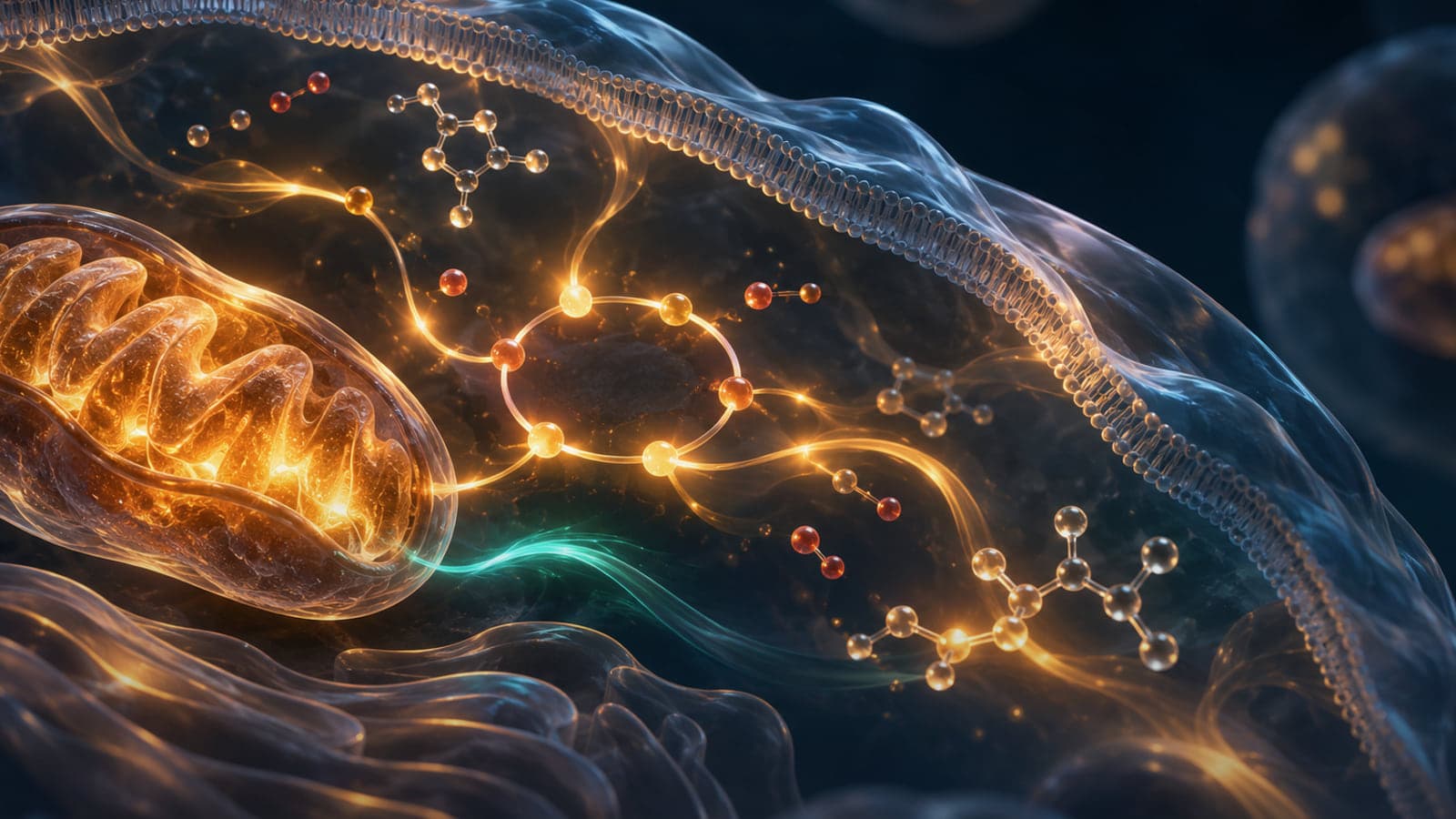
Mitochondria are best known for supporting ATP production, but their scientific importance extends beyond energy supply. They participate in metabolic reactions, calcium handling, stress signalling and decisions about cell survival. Their activity also depends on continual communication with the rest of the cell.
“Mitochondrial function” is therefore not one measurement. A study may investigate respiration, membrane potential, metabolite transport, network shape or removal of damaged organelles. Knowing which function was measured is essential when interpreting a claim.
How respiration supports ATP production
Fuel-derived electrons enter the respiratory chain through carriers including NADH. Electron transfer across a series of protein complexes helps establish an electrochemical gradient across the inner mitochondrial membrane. ATP synthase uses that gradient to support ATP production.
Oxygen acts as the terminal electron acceptor in the respiratory chain. Oxygen consumption can therefore provide information about respiration, but it is not identical to ATP production. Some respiration supports proton leak or other processes rather than ATP synthesis.
The distinction explains why a higher oxygen-consumption rate is not automatically a better result. It may reflect greater demand, greater capacity, altered coupling or stress. The experiment must distinguish these possibilities.
Compartments make metabolism possible
Mitochondria contain an outer membrane, an intermembrane space, an inner membrane and a matrix. These compartments create controlled environments for reactions and transport. The inner membrane is especially important because maintaining a gradient requires selective movement of molecules and ions.
Most mitochondrial proteins are encoded in the nucleus and imported, while mitochondrial DNA encodes a smaller set of components. This division of labour means that mitochondrial performance depends on both genomes and the machinery that coordinates them.
A useful modern example is NAD transport. Luongo and colleagues identified SLC25A51 as a transporter supporting mitochondrial NAD availability in mammalian systems. The work showed why a whole-cell metabolite measurement can miss a compartment-specific problem. Nature, 2020.
Mitochondria communicate with the cell
Changes in energy status, metabolites and redox conditions can influence signalling pathways and gene regulation. Mitochondria are therefore both recipients and sources of information. A stress response may alter nuclear gene expression, which in turn changes mitochondrial composition.
Mitochondrial-derived peptides are one area of interest within this wider communication network. Their study does not mean that every mitochondrial effect is peptide-mediated, or that a peptide associated with mitochondria directly improves every aspect of respiration. Each proposed pathway requires its own evidence.
Calcium also illustrates the connection between signalling and metabolism. Changes in calcium handling can affect metabolic activity, while excessive or poorly controlled calcium can contribute to dysfunction. The timing and location of a signal matter as much as its presence.
Quality control is a dynamic process
Mitochondria change shape through fusion and fission, processes that influence network organisation and segregation of damaged components. Cells can remove selected mitochondria through mitophagy, a form of autophagic quality control.
An image of a fragmented network does not, by itself, establish dysfunction. Network appearance depends on cell type, cell cycle and physiological state. Similarly, an increase in a mitophagy marker may reflect increased clearance or accumulation caused by a blocked downstream step.
Researchers therefore distinguish a static abundance measurement from flux through a process. Understanding what enters, leaves and accumulates in the pathway is more informative than measuring one marker at one time.
What common experiments actually measure
Respirometry measures oxygen consumption under defined conditions. ATP assays estimate ATP abundance or production-related signals. Membrane-potential probes report aspects of the electrochemical state but can be affected by loading and cell conditions. Imaging reveals structure, distribution and selected molecular markers.
Each assay needs appropriate normalisation. More cells can consume more oxygen without any change in function per cell. A treatment that reduces cell number can make a metabolic signal appear lower simply because less biological material remains.
Combining measurements helps separate these explanations. A respiratory result interpreted alongside cell viability, mitochondrial content and a relevant functional endpoint is more informative than a single fluorescent signal.
What remains uncertain in broad claims
A compound can change a mitochondrial marker indirectly by altering nutrient availability, cell growth or stress. Direct mitochondrial action requires additional evidence. Results from one cell type also need not apply to another with different energy demands.
Independent readers should ask whether a study measured capacity, current activity or damage. These are related but distinct concepts. The cell biology reference on mitochondria provides foundational context, while modern transport studies demonstrate how the field continues to refine that picture.
Frequently asked questions
Are mitochondria only ATP producers?
No. They contribute to metabolism, signalling, calcium regulation and cell-survival pathways.
Does more oxygen consumption mean better mitochondria?
Not necessarily. Coupling, demand, cell number and stress must be considered.
Is mitochondrial DNA the whole mitochondrial blueprint?
No. Most mitochondrial proteins are encoded by nuclear genes.
What is mitophagy?
A process through which cells selectively remove mitochondria using autophagic machinery.
Can total cellular NAD reveal mitochondrial NAD?
Not reliably in every situation. Compartment-specific changes may occur without a matching whole-cell change.
What makes a mitochondrial claim convincing?
Several compatible measurements, suitable controls and a clear explanation of the function being tested.
Related reading
Scientific references
-
Cooper (2000). The Cell: A Molecular Approach, 2nd edition. Mitochondria.
-
Luongo et al. (2020). SLC25A51 is a mammalian mitochondrial NAD+ transporter. Nature 588:174-179.
Questions about anything in this guide?
Message the team on WhatsApp for product, batch or documentation questions. We can't give dosing or medical guidance.
For laboratory research use only. Not for human or veterinary consumption. Nothing in this article is medical advice.


