
Cellular Biology
What Is NAD+? A Guide to Cellular Coenzymes and Redox Biology
Understand NAD+, NADH, redox reactions, salvage pathways and cellular compartments, with clear distinctions between coenzyme biology and product claims.
25 October 2026 · 4 min read · Novaryn Labs
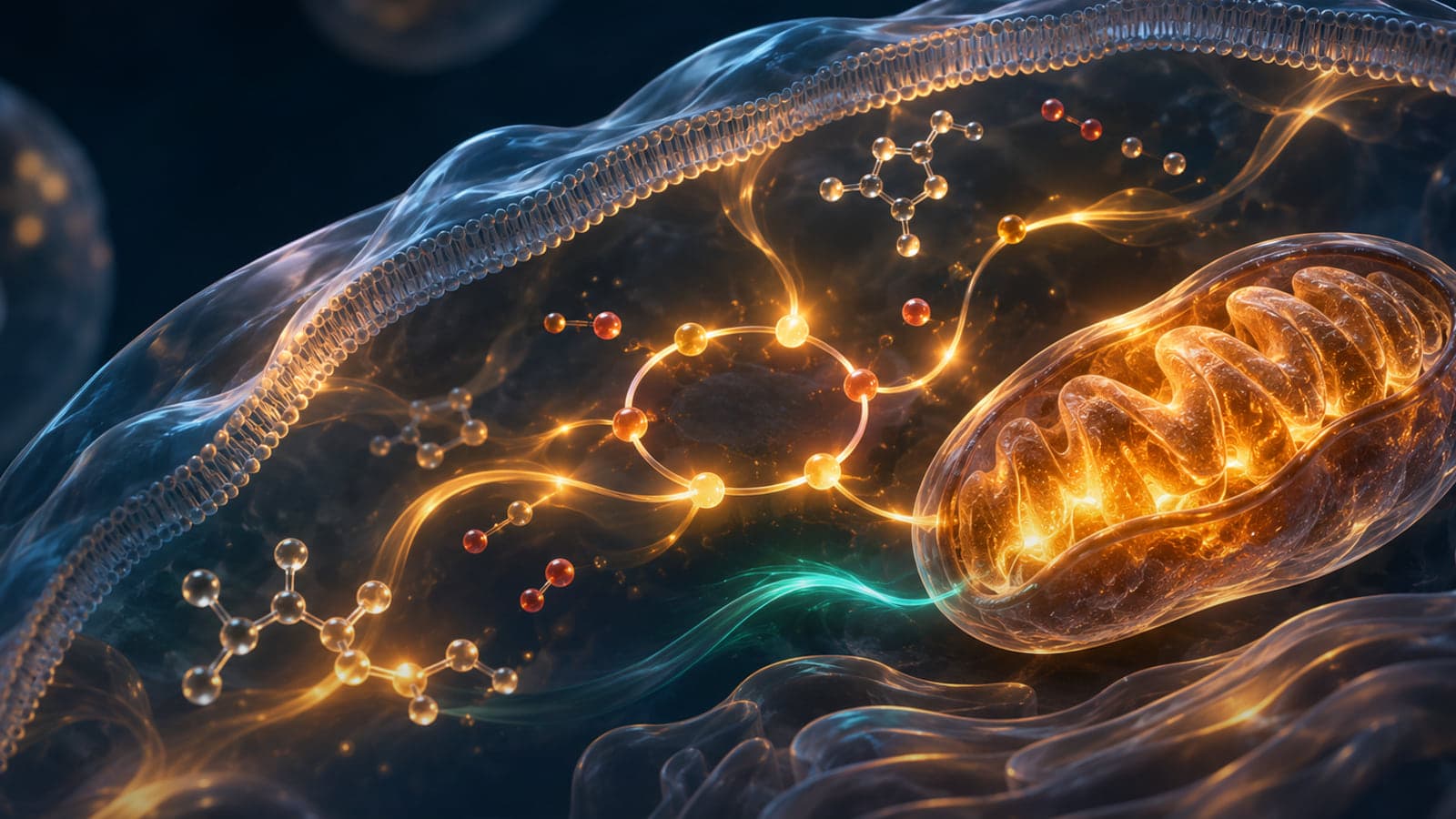
Nicotinamide adenine dinucleotide, abbreviated NAD, is a small coenzyme used throughout cellular metabolism. NAD+ is its oxidised form, while NADH is its reduced form. It is not a peptide, hormone or receptor agonist.
This guide explains the underlying biology rather than reviewing a particular research preparation. The distinction matters because the importance of endogenous NAD does not, by itself, establish what externally supplied material does in a cell, tissue or organism.
A coenzyme helps an enzyme perform chemistry
Many enzymes require a small molecular partner to carry out a reaction. NAD participates in reactions that transfer reducing equivalents between molecules. In a simplified description, NAD+ accepts a hydride equivalent and becomes NADH; another reaction can return it to NAD+.
This cycling connects fuel breakdown with other processes. In mitochondria, NADH supplies electrons to the respiratory chain. In the cytosol, maintaining available NAD+ is important for reactions including part of glycolysis. The coenzyme is reused through many reactions rather than acting as a one-time energy packet.
ATP and NAD consequently have different roles. ATP commonly couples energy-releasing reactions to cellular work, whereas NAD participates in redox chemistry and serves as a substrate for other enzymes. Calling both “energy molecules” hides that distinction.
Redox state and pool size are different measurements
A cell’s total NAD-related pool and its NAD+/NADH balance are not the same variable. The pool can change in size while its redox balance remains similar, or the balance can shift without a large change in the total.
A measurement from a whole-cell extract also combines compartments with different metabolic roles. The nucleus, cytosol and mitochondria do not necessarily respond identically. Sample preparation can further affect unstable metabolites, so measurement methods and handling are central to interpretation.
Researchers should specify whether they measured NAD+, NADH, their ratio, total abundance or flux through a pathway. These quantities cannot be substituted for one another.
NAD is also consumed by signalling enzymes
Some enzymes use NAD+ as a substrate and cleave it rather than simply cycling it between oxidised and reduced states. These include sirtuins, poly(ADP-ribose) polymerases and enzymes involved in NAD metabolism such as CD38.
Consumption links NAD availability to processes including protein modification and DNA-damage responses. It also means cells must continually replenish their pools. The effect of changing NAD availability depends on which enzymes are present, their location and their substrate requirements.
An increase in total NAD does not prove that every NAD-dependent enzyme becomes more active. Enzyme abundance, competing reactions and local availability can all limit the response.
Salvage and synthesis maintain the system
Cells can recover nicotinamide through salvage pathways and use other biosynthetic routes depending on tissue and context. In the commonly discussed nicotinamide salvage route, NAMPT and NMNAT enzymes participate in rebuilding NAD.
Precursor availability is only one part of this network. Transport, enzyme regulation and consumption influence the final pool. A pathway diagram showing a precursor upstream of NAD establishes a biochemical relationship, not a guaranteed effect in every experimental model.
NNMT connects to this network by methylating nicotinamide. Its activity also uses a methyl donor, linking nicotinamide handling with methyl metabolism. That connection is scientifically interesting precisely because it is a network interaction rather than a simple on-off control of NAD.
Compartment-specific studies changed the picture
Ryu and colleagues studied how compartmentalised NAD synthesis influenced adipocyte differentiation and transcriptional regulation. Their work linked local NAD availability to PARP-1-related regulation in experimental models. It provides an example of location shaping function. Science, 2018.
Later work identified SLC25A51 as a mammalian mitochondrial NAD transporter. Genetic perturbation helped distinguish mitochondrial NAD availability from the total cellular pool. Luongo and colleagues, Nature, 2020.
These findings support specific cellular mechanisms. They should not be converted into claims that any NAD-labelled product reaches every relevant compartment or reproduces the same biological changes.
Research applications and unresolved questions
NAD research can investigate metabolic flux, DNA-damage responses, mitochondrial transport and the relationship between nutrient state and gene regulation. Isotope tracing can help distinguish where atoms travel, while targeted genetic changes test the role of particular enzymes or transporters.
Important uncertainties include tissue-specific regulation, compartment measurement and the consequences of sustained changes in consumption or synthesis. A response beneficial for one experimental endpoint may not be favourable for another.
Independent evaluation should therefore separate three questions: what NAD normally does, what manipulation the study performed, and what outcome that manipulation demonstrated. This keeps foundational biochemistry connected to evidence without turning it into a product promise.
Frequently asked questions
Is NAD+ a peptide?
No. It is a nucleotide-derived coenzyme.
Is NADH the same molecule as NAD+?
They are the reduced and oxidised forms of the same coenzyme system, with different redox roles.
Is NAD+ the same as ATP?
No. They participate in different kinds of cellular chemistry.
What is the salvage pathway?
A set of reactions that recycles breakdown products such as nicotinamide into NAD.
Why do cellular compartments matter?
Local availability can influence enzymes differently even when whole-cell abundance changes little.
Does biological importance establish an external material’s effect?
No. Uptake, metabolism, localisation and measured outcomes require separate evidence.
Related reading
Scientific references
Questions about anything in this guide?
Message the team on WhatsApp for product, batch or documentation questions. We can't give dosing or medical guidance.
For laboratory research use only. Not for human or veterinary consumption. Nothing in this article is medical advice.


