
Cellular Biology
Understanding NNMT and Nicotinamide Metabolism
Explore how NNMT connects nicotinamide, methyl donors and cellular metabolism, and why enzyme inhibition claims require tissue-specific evidence.
25 October 2026 · 4 min read · Novaryn Labs
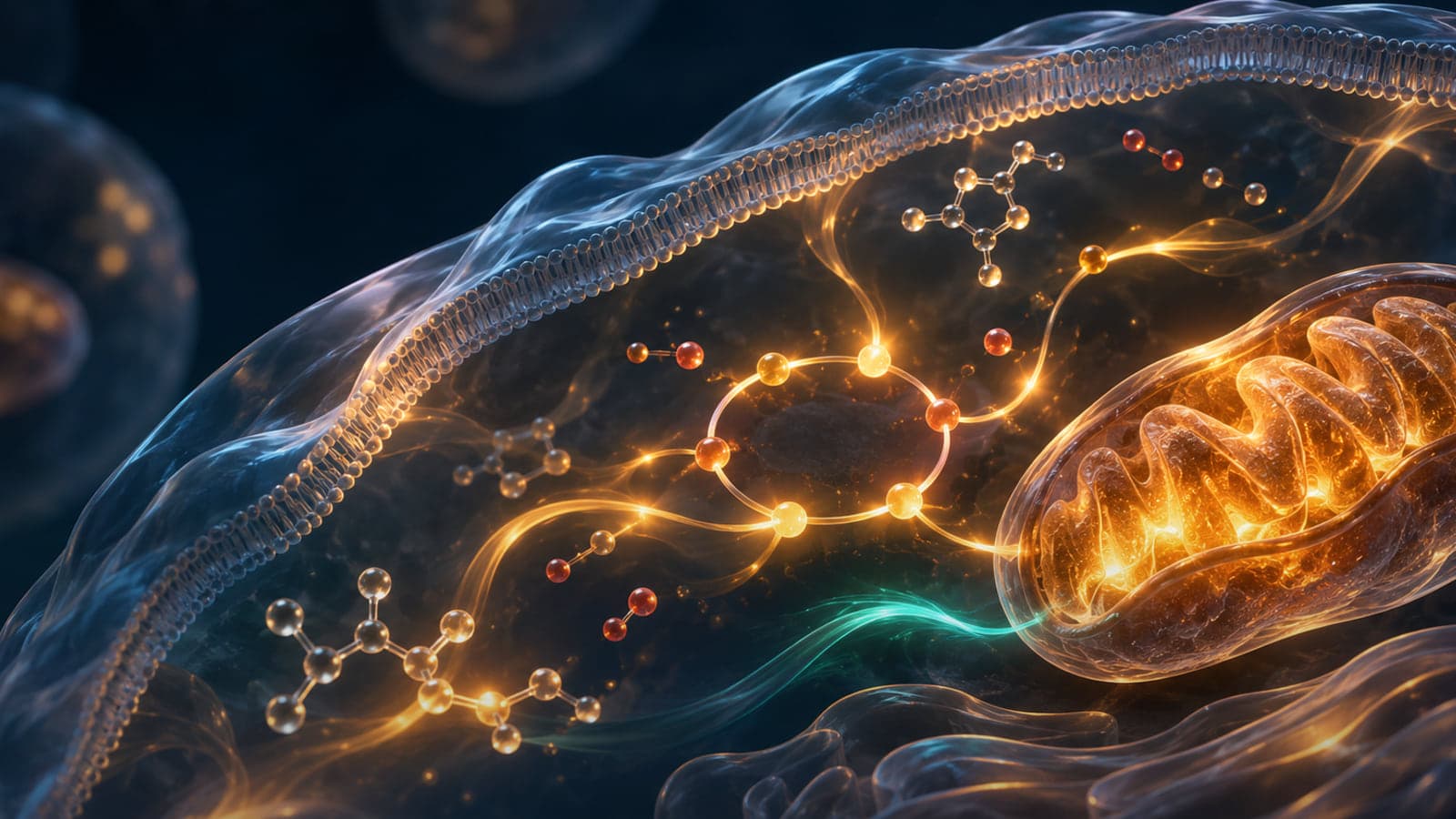
Nicotinamide N-methyltransferase, or NNMT, is an enzyme that transfers a methyl group to nicotinamide. That reaction connects two important areas of cell biology: handling of a vitamin B3-related molecule and the use of methyl donors.
NNMT is interesting because metabolism is not only about generating energy. Metabolic reactions can influence the chemical resources available for protein and chromatin modification. Studying NNMT therefore links enzymology, nutrient handling and gene regulation, without reducing the system to a simple NAD-boosting switch.
The reaction and its immediate products
NNMT uses S-adenosylmethionine, commonly abbreviated SAM, as a methyl donor. It converts nicotinamide into 1-methylnicotinamide and produces S-adenosylhomocysteine, or SAH, from the donor.
Nicotinamide also participates in NAD salvage. The NNMT reaction therefore provides one route by which nicotinamide is handled within a wider network. The balance among routes depends on enzyme expression, substrate availability and tissue context.
The presence of this connection does not mean that changing NNMT automatically causes a predictable change in every NAD pool. Cells regulate synthesis, consumption, transport and compartmentalisation simultaneously.
Why methyl-donor balance matters
Methyl groups are used in reactions involving DNA, histones and other molecules. The availability of SAM and the accumulation of SAH can influence the environment in which methyltransferases operate.
Ulanovskaya, Zuhl and Cravatt examined NNMT in cancer-cell models and described a metabolic methylation-sink mechanism. Their work connected NNMT activity with altered methyl-donor balance and protein methylation patterns. Nature Chemical Biology, 2013.
This was a mechanistic finding in particular experimental systems. It does not establish that NNMT has the same role in every tissue or that inhibiting it produces a uniform beneficial effect. The cellular background and nutrient conditions are part of the result.
Metabolic research extends beyond cancer cells
Kraus and colleagues investigated NNMT knockdown in relation to diet-induced obesity in mice. The study helped establish NNMT as a target of interest in metabolic biology. Nature, 2014.
The important distinction is between genetic or gene-expression manipulation and a particular chemical inhibitor. Reducing expression changes the abundance of an enzyme; a small molecule may inhibit activity incompletely, reach tissues unevenly or affect other targets.
Evidence from a knockdown experiment can motivate inhibitor research, but it cannot serve as direct proof that every NNMT-labelled inhibitor reproduces the same result. That requires compound-specific experiments.
Enzyme inhibition is a measurable claim
An inhibitor study should establish activity against NNMT using an appropriate biochemical assay. It should then test whether the compound reaches the relevant cellular setting and changes a compatible pathway readout.
Selectivity is especially important because methyltransferases and other metabolic enzymes share some chemical features. A compound that alters several enzymes may produce an endpoint through more than one mechanism. A narrow assay panel leaves uncertainty about untested interactions.
Target engagement, metabolite measurements and genetic controls can help connect the compound to the proposed mechanism. If removing NNMT changes the compound’s effect, that can be informative, although compensatory changes still need consideration.
Metabolite abundance is not metabolic flux
A larger pool of a metabolite can result from increased production, reduced consumption or altered transport. It does not necessarily mean that more material is flowing through the pathway of interest.
Isotope tracing can help investigate flux by following labelled atoms. Measurements of nicotinamide, methylated products, SAM, SAH and NAD-related pools can provide a more complete picture than one endpoint alone.
Timing also matters. An immediate enzyme response and a later gene-expression response may be connected through several intermediate steps. A study should avoid presenting all changes as direct consequences of binding to NNMT unless the evidence supports that interpretation.
What remains unresolved
Important questions include how NNMT functions in different tissues, how its products contribute to biology and how sustained inhibition affects compensatory pathways. The interaction between nicotinamide handling and methyl metabolism can vary with nutrient conditions and disease models.
For research compounds such as 5-Amino-1MQ, readers should follow the exact molecule and assay rather than transferring results from all NNMT research. A shared target creates a scientific rationale, not automatic equivalence.
Independent assessment is most useful when it separates enzyme chemistry, cell-level effects, animal findings and human evidence. This preserves the genuine interest of the pathway while avoiding an unsupported leap from mechanism to outcome.
Frequently asked questions
Is NNMT a peptide?
NNMT is a protein enzyme. Compounds studied as NNMT inhibitors may belong to different chemical classes.
Is 5-Amino-1MQ a peptide?
No. It is a small-molecule research compound, not an amino-acid chain.
Does NNMT directly make NAD+?
No. It methylates nicotinamide, which also participates in NAD-related metabolism.
What is a methylation sink?
In the cited research context, it describes diversion of methyl groups into a product that changes the available methyl-donor balance.
Does knockdown prove an inhibitor will work identically?
No. Genetic and chemical interventions differ in specificity, timing and distribution.
What evidence would strengthen an inhibitor claim?
Biochemical activity, cellular target engagement, relevant metabolite changes and controls that test whether NNMT explains the endpoint.
Related reading
Scientific references
Questions about anything in this guide?
Message the team on WhatsApp for product, batch or documentation questions. We can't give dosing or medical guidance.
For laboratory research use only. Not for human or veterinary consumption. Nothing in this article is medical advice.

