Metabolic Research
The Science of Metabolic Regulation: Flux, Feedback and Organ Crosstalk
Understand metabolic flux, insulin signalling, nutrient sensing and organ interactions, and why one biomarker cannot describe whole-body metabolism.
25 October 2026 · 5 min read · Novaryn Labs
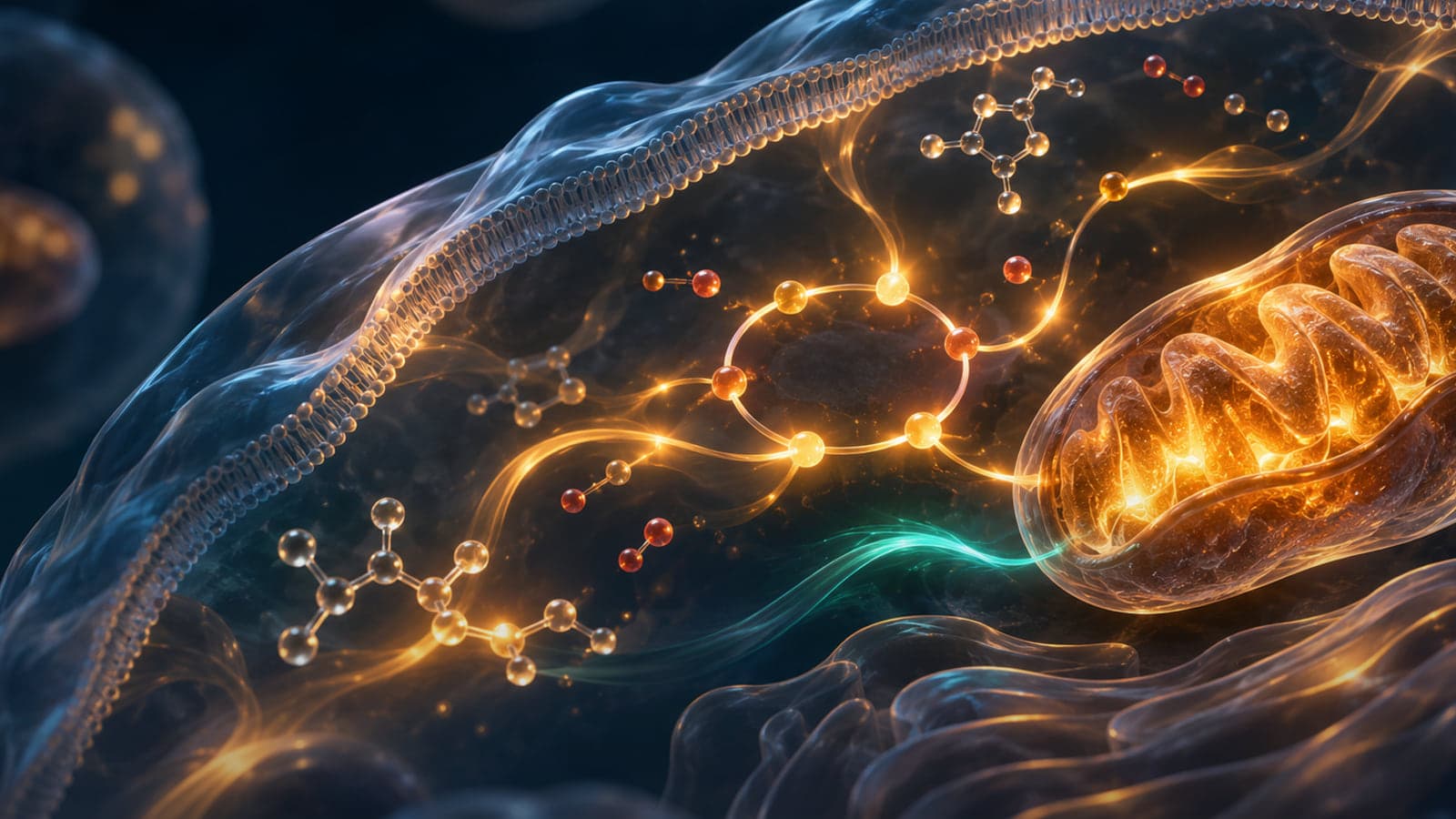
Metabolism is the organised network of chemical reactions that sustains cells. Regulation determines when those reactions occur, how quickly material moves through them and how resources are distributed among tissues.
This is broader than energy expenditure or body weight. A metabolic study may concern glucose transport, lipid storage, amino-acid use, redox balance or gene regulation. The most useful interpretation identifies the particular process before drawing a broader conclusion.
Pathways are connected through shared resources
Cells break down nutrients, build molecules and exchange metabolites with their surroundings. ATP, reducing equivalents and carbon-containing intermediates link these activities.
A change in one pathway can redirect resources into another. For example, reduced use of a substrate in one tissue may increase its availability elsewhere. This means an isolated cell result cannot always predict the integrated response of an organism.
Feedback also operates at several timescales. Enzyme activity can change quickly through binding or phosphorylation. Gene expression and tissue composition can change more slowly. A short experiment and a long experiment may therefore capture different parts of the response.
Flux is not the same as concentration
Metabolite concentration describes how much of a substance is present in a sampled pool. Flux describes the rate at which material moves through a pathway. A pool can remain steady while production and consumption both increase.
Conversely, a metabolite can accumulate because its consumption has slowed rather than because production has accelerated. This is why a larger measured pool does not necessarily mean that a pathway is working faster.
Stable-isotope tracing can help follow atoms through reactions. Combined with suitable modelling and other measurements, it provides information that a static concentration cannot. The assumptions and sampling strategy still need to be examined.
Hormones coordinate tissues
Insulin, glucagon, incretins and other hormones help coordinate nutrient handling across organs. Their receptors initiate signalling, but the final response depends on tissue identity and physiological state.
The liver, skeletal muscle and adipose tissue perform different roles. A change that appears small in one tissue can be compensated elsewhere, while a local defect can alter the distribution of fuels without producing the most obvious expected blood-marker change.
Brüning and colleagues demonstrated this complexity using mice with a muscle-specific insulin receptor disruption. The model showed altered lipid-related features without the simple glucose-tolerance outcome that might have been predicted from muscle signalling alone. Molecular Cell, 1998.
The study is not a human treatment result. It is evidence that integrated metabolism can respond in ways that a one-pathway explanation misses.
Nutrient sensors connect supply with cellular decisions
AMPK responds to energetic conditions and can influence the balance between resource-consuming and resource-generating activities. Other systems, including mTOR-related signalling, integrate nutrient and growth inputs.
These pathways are often presented as opposing switches, but the real network is more contextual. Cells need both maintenance and growth-related functions, with regulation depending on timing and environment.
A change in a phosphorylation marker supports a signalling observation. It does not establish a whole-body metabolic outcome without relevant functional measurements. Direct and indirect effects also need to be separated.
Body weight is an integrated but incomplete endpoint
Body weight reflects multiple components, including fat, lean tissue and water. A change in total weight does not explain which component changed or why.
Likewise, food intake, energy expenditure and nutrient absorption contribute to energy balance but require different measurements. A study attributing a result to increased expenditure should measure or otherwise convincingly establish that mechanism rather than inferring it from weight alone.
In animal studies, body size and composition complicate comparisons of metabolic measurements. Normalisation and statistical modelling should match the question. Dividing every measurement by body weight can introduce its own distortions.
Multi-receptor and enzyme-targeted research
Compounds acting at GLP-1, GIP and glucagon receptors investigate coordinated endocrine signalling. NNMT inhibitors address a different part of metabolism involving nicotinamide and methyl-donor handling. Mitochondrial peptides raise still other questions about cellular stress and energy regulation.
These are related research areas, but they should not be merged into a generic metabolic-benefit category. Each compound needs evidence for its exact target engagement and measured outcome.
Willard and colleagues’ receptor work on tirzepatide illustrates how detailed pharmacology can differ across targets and readouts. It supplies mechanistic information, not a complete explanation of every organism-level endpoint. JCI Insight, 2020.
Building a stronger metabolic explanation
A strong study combines compatible measurements: signalling, relevant metabolites or flux, tissue context and an endpoint that matches the claim. It also considers alternative explanations such as changed cell number, food intake or stress.
Independent readers should identify whether a result concerns capacity, current activity or adaptation. Increased capacity does not necessarily mean increased activity under ordinary conditions, and adaptation does not automatically imply improvement.
The most informative conclusion states which process changed and in which model. That precision makes it easier to connect studies across the metabolic network without overstating what any one experiment proves.
Frequently asked questions
Is metabolism the same as calorie burning?
No. It includes synthesis, breakdown, transport and regulation of many molecules.
Does a higher metabolite level mean more pathway activity?
Not necessarily. Production, consumption and transport all influence the level.
Can one tissue compensate for another?
Yes. Integrated physiology can redistribute fuels and responses across organs.
Does weight change identify the mechanism?
No. Body composition and the relevant physiological processes require separate assessment.
Is AMPK activation proof of improved metabolism?
No. It can indicate an adaptive response to energetic stress.
What should a metabolic claim specify?
The process, model, measurement and uncertainty, rather than relying on a broad label.
Related reading
GLP-1, GIP and glucagon receptors
Scientific references
Questions about anything in this guide?
Message the team on WhatsApp for product, batch or documentation questions. We can't give dosing or medical guidance.
For laboratory research use only. Not for human or veterinary consumption. Nothing in this article is medical advice.