Hormonal Signalling
GLP-1, GIP and Glucagon Receptors Explained
Compare three metabolic hormone receptors, their signalling and tissue context, and the evidence needed to interpret dual and triple agonist research.
25 October 2026 · 4 min read · Novaryn Labs
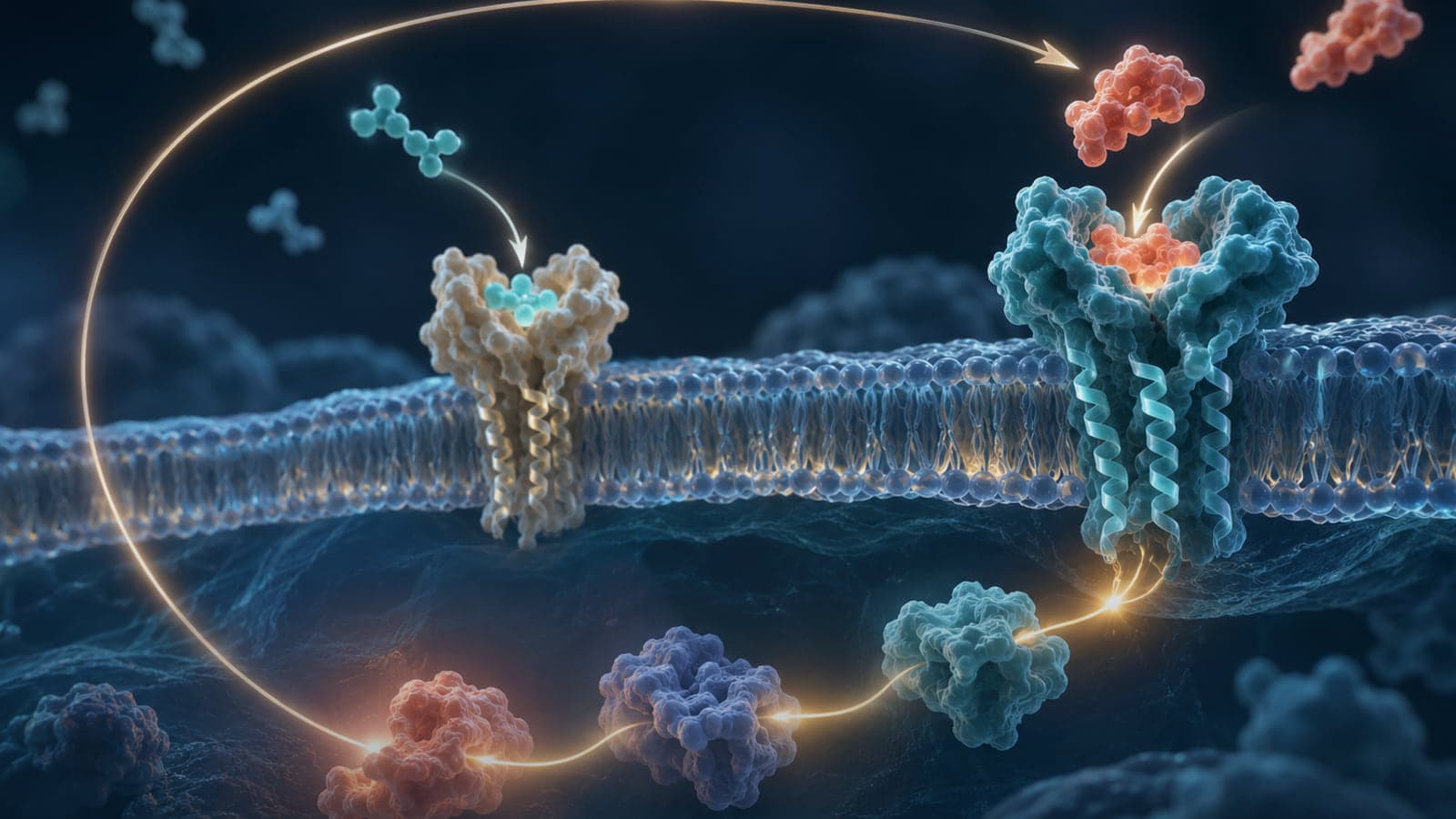
GLP-1, GIP and glucagon are peptide hormones involved in coordinating metabolism. Their receptors belong to the class B family of G protein-coupled receptors, but they are not interchangeable targets. Each operates within a different pattern of tissue expression and physiological regulation.
The growing interest in dual and triple receptor agonists makes this distinction especially important. Activating several receptors does not simply multiply one effect. It combines signals whose balance, timing and distribution must be studied experimentally.
GLP-1 and GIP are incretin hormones
The incretin concept describes gut-derived signals that help link nutrient intake with insulin secretion. GLP-1 and GIP contribute to this network through their own receptors. Their actions depend on glucose and the physiological state of the responding cells.
GLP-1 receptor signalling is also studied in relation to neural and gastrointestinal processes. GIP receptor biology extends beyond a single pancreatic endpoint. A receptor’s role cannot be fully described by one familiar clinical association.
Importantly, hormone names and receptor names are distinct. GLP-1 is a ligand; GLP-1R is its receptor. A synthetic agonist may interact with the receptor without being identical to the natural hormone.
Glucagon connects to a different metabolic role
Glucagon is strongly associated with hepatic regulation of fuel availability, including glucose production. Its receptor participates in signalling that differs in physiological consequence from the insulin-secretory role often used to introduce incretins.
This difference makes multi-receptor research interesting rather than contradictory. Scientists investigate whether coordinated activation can produce an integrated metabolic profile under specific conditions. The outcome depends on receptor balance and the organism’s response, not simply on whether one isolated action sounds desirable.
A claim about a triple agonist therefore needs evidence about the actual molecule. It cannot be inferred by adding together textbook descriptions of three natural hormones.
Shared signalling does not mean identical biology
These receptors can engage cyclic AMP-related pathways, but cells interpret that signal through their own machinery. Receptor abundance, coupling efficiency and regulatory proteins affect the response.
Ligands can also differ in receptor internalisation and recruitment of signalling partners. A molecule that produces one pattern of cyclic AMP activity may not produce the same pattern of arrestin recruitment or receptor trafficking as the natural ligand.
Willard and colleagues examined tirzepatide in experimental receptor systems and reported distinct pharmacological profiles at GIP and GLP-1 receptors. Their work demonstrates why dual agonism needs a detailed description rather than a binary yes-or-no label. JCI Insight, 2020.
Potency ratios depend on the assay
A reported balance between receptors depends on the expression system, endpoint and conditions. Protein binding can change the freely available fraction of a compound. Receptor overexpression can amplify a response that would be smaller in native tissue.
Comparisons are most interpretable when the same study uses well-characterised assays and suitable reference ligands. Numbers taken from unrelated experiments may not form a reliable receptor ranking.
Even a careful in vitro comparison does not establish the integrated in vivo balance. Distribution, degradation and tissue access can alter which receptors are engaged over time.
Single molecules and mixtures are different strategies
A multi-receptor agonist is one molecule designed or found to act at more than one receptor. A mixture contains separate components. These approaches differ in relative exposure, distribution and stability.
Evidence for a single dual agonist is therefore not evidence for an arbitrary blend of two compounds. Likewise, evidence for each component separately does not demonstrate the effect of their combination. Interaction studies are needed to establish what the actual combination does.
This distinction is especially useful when reading catalogue terminology. A product label such as GLP-2T or GLP-3R should not be interpreted as a formal biological receptor name. The catalogue’s verified molecular identity must be checked separately.
How researchers connect receptors to outcomes
Cell assays can establish receptor activity and signalling characteristics. Genetic receptor models can help test which target contributes to an observed response. Animal and human studies examine integrated outcomes, each with their own limits.
A change in body weight, glucose handling or another endpoint does not by itself reveal the contribution of each receptor. Mechanistic studies are needed to separate altered intake, energy expenditure, tissue metabolism and other factors.
Independent reading should keep two evidence tracks visible: molecular pharmacology and outcome studies. Agreement between them supports an explanation, while discrepancies can identify important biology that a simplified receptor story misses.
Frequently asked questions
Are GLP-1, GIP and glucagon the same hormone?
No. They are distinct peptide hormones with distinct receptors and overlapping metabolic networks.
Does dual agonist mean equal activity at both receptors?
No. Activity can be imbalanced and can vary by assay endpoint.
Is a triple agonist equivalent to a three-compound mixture?
No. A single molecule and a mixture have different pharmacological properties.
Does more receptor activity always produce a better outcome?
No. Balance, tissue context and the endpoint determine the interpretation.
Is GLP-2T the GLP-2 receptor?
No. A commercial product label must not be confused with the separate biological GLP-2 receptor system.
What should a receptor comparison report?
The exact ligand, receptor system, reference compound, readout and relevant experimental conditions.
Related reading
Scientific references
Questions about anything in this guide?
Message the team on WhatsApp for product, batch or documentation questions. We can't give dosing or medical guidance.
For laboratory research use only. Not for human or veterinary consumption. Nothing in this article is medical advice.