Metabolic Research
Retatrutide Research: GLP-1, GIP and Glucagon Receptor Biology
Understand retatrutide, listed as GLP-3 (R), through triple-receptor pharmacology, verified trial findings and important research uncertainties.
7 November 2026 · 10 min read · Novaryn Labs
Introduction
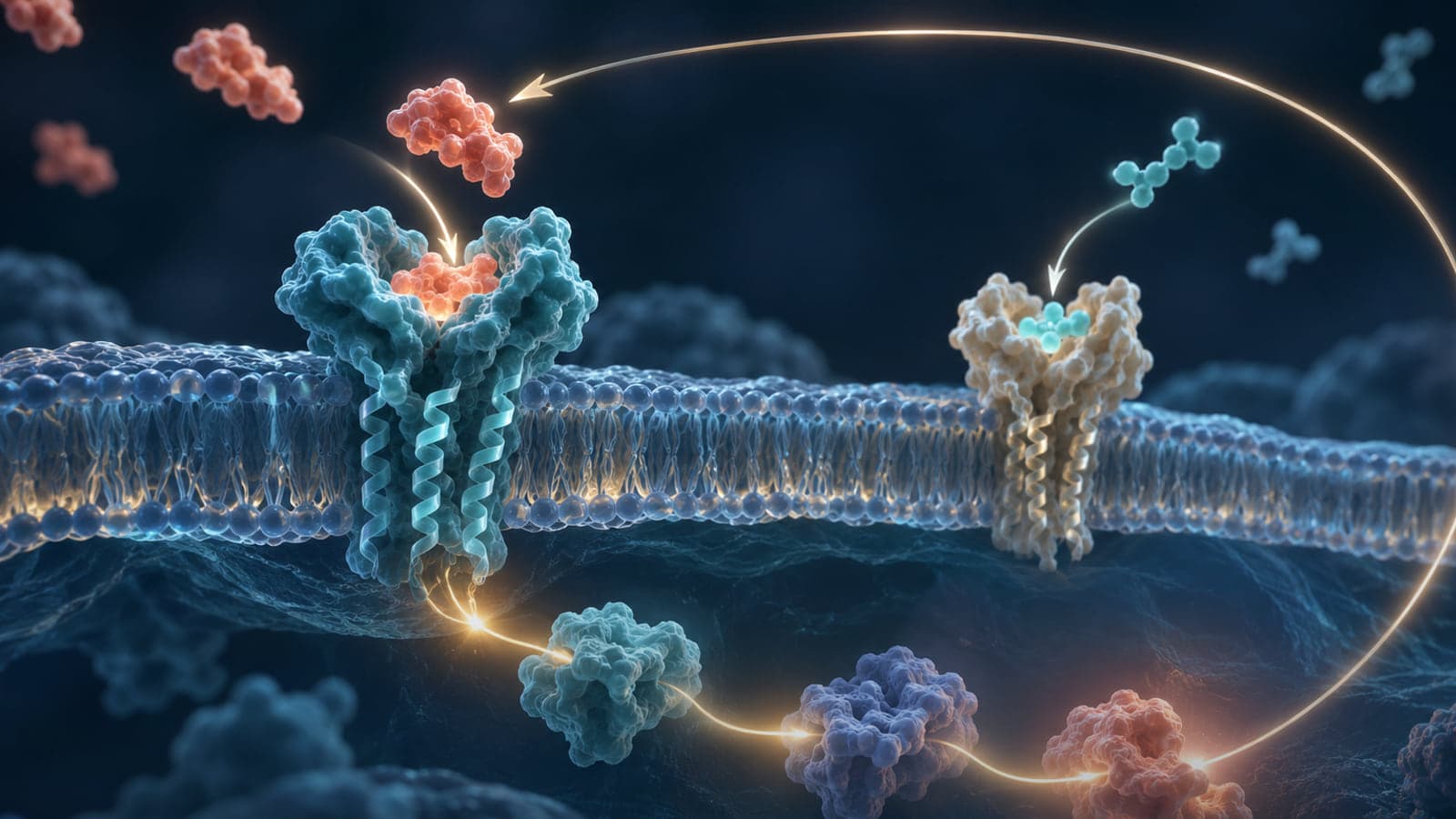
Glucagon is often introduced as a hormone that supports glucose availability, whereas incretins are usually discussed in relation to insulin secretion. Retatrutide brings these systems into the same molecular design. It is an investigational synthetic peptide with activity at the GLP-1, GIP and glucagon receptors. That makes it a particularly useful subject for understanding why metabolic regulation cannot be reduced to one hormone moving one measurement in one direction.
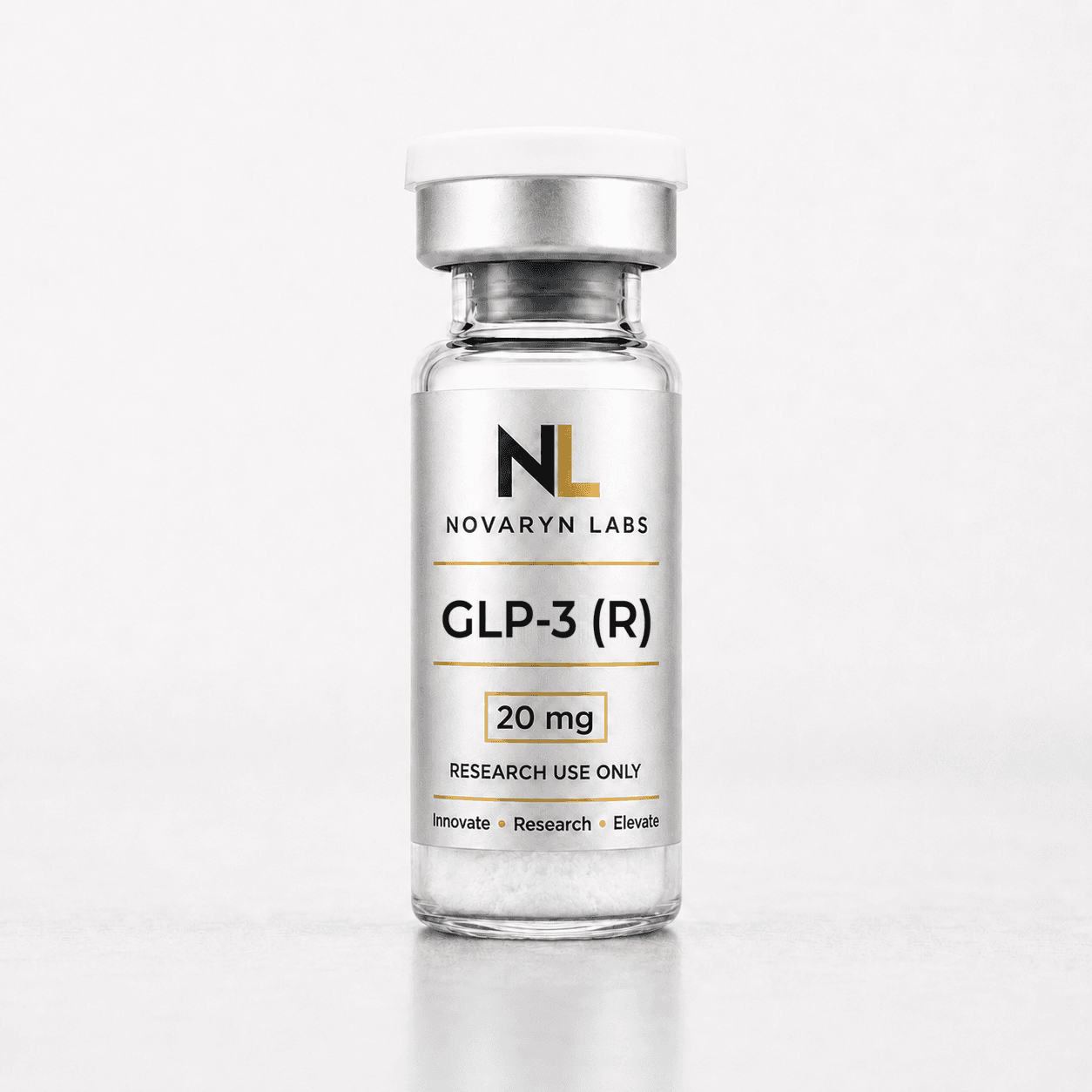
Novaryn Labs lists the corresponding research compound as GLP-3 (R). The name is a catalogue designation, not the name of a newly discovered natural hormone. The scientific literature uses retatrutide and the development identifier LY3437943. Searching these identifiers helps keep original studies separate from general discussion of incretin compounds.
The appeal of triple-receptor research is the opportunity to investigate coordinated physiology. The difficulty is assigning causes when several signals change together. A reduction in body mass, for example, does not by itself reveal the contributions of food intake, energy expenditure or altered substrate handling. This article considers how researchers approach those questions and why encouraging clinical findings still require careful interpretation.
What exactly is retatrutide?
Retatrutide is one engineered peptide, rather than a blend of three separately supplied hormones. Its design permits activity at three related metabolic receptors. The catalogue identifies the corresponding compound by CAS number 2381089-83-2 and supplies it for laboratory research.
Coskun and colleagues described the discovery and early investigation of LY3437943 in 2022. Their programme connected receptor pharmacology, animal experiments and early human observations. That sequence is scientifically important: activity in a receptor assay was one stage in building an evidence base, not the final proof of every proposed application. Discovery and clinical proof-of-concept paper
A catalogue vial is not the clinical study material. Manufacturing specifications, formulation, analytical release criteria and oversight may differ. Even when the intended molecular identity is the same, researchers must establish the characteristics of the actual material used in their own work.
How three receptor systems create a research question
The GLP-1 and GIP receptors form the incretin part of the design. The glucagon receptor adds another signalling dimension. Retatrutide's triple activity is established at the compound level in the cited discovery research, but the presence of three targets does not imply equal activity at each or a fixed division of physiological responsibility.
A useful way to interpret a multi-receptor experiment is to separate three questions. First, is the receptor present in the model? Second, does the compound produce a measurable response through it? Third, does that response explain the endpoint being studied? Skipping the third question can turn receptor activity into an unsupported account of whole-organism behaviour.
For example, changes in glucose measurements and changes in body composition may occur in the same experiment without sharing a single explanation. The timing of observations matters, as does the choice of comparison group. A receptor-selective comparator can help, but only if relevant differences in exposure and experimental context are also considered.
The term synergy should therefore be used carefully. Demonstrating that one multi-target molecule has an effect is not the same as proving that its targets interact synergistically. Such a claim needs a comparison capable of distinguishing the combined response from the responses expected from its components.
Hepatic signalling and lipid-related proteins
Wen and colleagues investigated circulating ANGPTL3/8 and primary human hepatocytes in 2025. Retatrutide reduced hepatocyte secretion of this lipid-regulating protein complex, and a glucagon-receptor-blocking antibody prevented the effect. This provides a specific experimental connection between glucagon-receptor activity and a hepatic endpoint, rather than attributing every metabolic change to body-weight reduction. Hepatocyte study
A 2026 metabolite-profile analysis also linked retatrutide-associated changes with fatty-acid oxidation and amino-acid metabolism. The authors discuss glucagon signalling through cyclic AMP and protein kinase A as part of the proposed hepatic mechanism. These pathway interpretations combine measured circulating metabolites with biological inference; a blood metabolite pattern is not a direct measurement of every intracellular reaction. Metabolic profile analysis
Why researchers are interested
The glucagon dimension
Adding glucagon-receptor activity makes retatrutide a tool for asking how several hormonal pathways can be coordinated within one molecule. It also creates the need to measure competing or complementary effects rather than choosing only the most favourable endpoint. A research programme focused solely on body mass would leave important metabolic questions unanswered.
Energy balance as a set of measurements
Energy balance is often discussed as though it were a single observable property. In practice, researchers need separate measurements and an explicit model connecting them. Food intake, expenditure, body composition and substrate-related measurements each contribute different information. A change in one does not prove a change in all the others.
Translational design
Retatrutide research illustrates the challenge of moving from a simplified receptor assay to integrated physiology. The more complex the model, the more opportunities there are for feedback and indirect effects. That complexity is part of the scientific attraction, but it also makes strong controls and cautious attribution especially valuable.
What the research shows
Early discovery work
The 2022 Coskun paper describes receptor activity and experiments in obese mice alongside an early clinical investigation. It supports further study of a single molecule targeting the three receptors. The preclinical findings must remain identified as preclinical: animal conditions, metabolic state and experimental measurements are not interchangeable with human outcomes. Coskun and colleagues
The methodological lesson is that a development programme can combine complementary evidence without collapsing it into one category. Mechanistic plausibility and an observed clinical response are related, but they answer different questions.
The 2023 phase 2 obesity trial
Jastreboff and colleagues reported a double-blind, randomised, placebo-controlled phase 2 trial involving 338 adults. The study assessed body-weight change and adverse events over 48 weeks. It found substantial mean weight reductions in retatrutide groups, with gastrointestinal events among the principal tolerability findings. The report also described heart-rate changes. These findings concern a monitored clinical study, not an assurance about independently sourced material. Phase 2 trial
A phase 2 trial is informative about the population and conditions studied, but it cannot settle every question about durability, uncommon events or comparative performance. The result should be interpreted alongside eligibility criteria, participant withdrawals and the prespecified endpoints rather than a single headline number.
Phase 3 evidence published in 2026
Jastreboff and colleagues published TRIUMPH-1 in September 2026. This randomised, double-blind trial included 2,339 adults with obesity without diabetes and compared retatrutide with placebo over 80 weeks. Using the treatment-regimen estimand, mean body-weight change ranged from -17.6% to -25.0% across the retatrutide groups, compared with -3.9% for placebo. The trial also assessed prespecified outcomes in knee osteoarthritis and obstructive sleep apnoea subgroups. Its analyses used different strategies for handling intercurrent events across endpoint groups, so the statistical framework matters when interpreting the results. TRIUMPH-1 publication
Bellido and colleagues reported TRIUMPH-2 in The Lancet in 2026. This double-blind, randomised phase 3 trial involved 1,152 adults with obesity or overweight and type 2 diabetes. For the treatment-regimen estimand at 80 weeks, mean body-weight change ranged from -11.9% to -18.8% in the retatrutide groups versus -5.1% with placebo. Gastrointestinal events were more common with retatrutide; hypotension and dysaesthesia were also reported more frequently. The selected diabetes population and treatment-discontinuation findings are important limits on interpretation. TRIUMPH-2 publication
These publications mean the evidence is no longer confined to the earlier phase 2 programme. They still do not justify ranking retatrutide against another compound using unrelated trials, nor do they establish the identity or suitability of independently supplied laboratory material. This review was checked on 25 October 2026 and remains a selected evidence account rather than an exhaustive regulatory summary.
Community discussion: comparisons and uncertainty
One verified public discussion explicitly challenges the idea that retatrutide is automatically better than tirzepatide. Comments describe different subjective appetite experiences and concerns about unwanted effects, while others question whether anecdotes can establish a comparison. Community discussion
Those disagreements are useful as examples of questions people bring to the literature. They are not evidence that either compound has a predictable effect for an individual. The identity of reported materials is unverified, participants are self-selected and surrounding circumstances differ. Their observations cannot isolate glucagon-receptor activity from the rest of the experience.
A primary qualitative research record from Swansea University also describes how online weight-training communities frame GLP-1 compounds and retatrutide. Its subject is discussion and risk perception, not biological efficacy. That distinction matters: studying what people believe is valid research, but the findings do not verify the beliefs themselves. University research record
Potential laboratory applications
Comparing receptor responses
A characterised research sample may support work comparing functional responses across GLP-1R, GIPR and glucagon-receptor systems. The study should explain why each endpoint was selected and whether the assays are comparable. A larger signal in one platform may reflect the platform rather than intrinsically stronger activity.
Connecting analytical and biological measurements
A laboratory can investigate whether chemical changes observed during a defined stability study coincide with changes in receptor response. This separates identity, composition and function rather than assuming that one measurement represents all three. It also creates a more useful record when another laboratory attempts to reproduce the work.
Interpreting complex outcomes
Retatrutide provides a case study in causal reasoning. Researchers can ask which observations would support a proposed mechanism and which would contradict it. Writing those expectations before examining results makes it harder to construct an attractive explanation only after the outcome is known.
What remains unknown?
The exact contribution of each receptor to every observed clinical endpoint remains a complex question. Human findings do not provide direct access to every relevant tissue response, and simplified assays cannot recreate all physiological feedback. Comparative claims also require appropriate direct evidence; ranking compounds across unrelated studies can be misleading.
Batch-specific unknowns are separate. A published paper cannot verify the identity, stability or impurity profile of the material in a particular laboratory. The experimental record should link the product, lot, analytical documentation and actual sample used. The batch traceability guide explains why that connection matters.
Independent reading should include the original methods and the limitations reported by investigators. If a proposed research claim depends on a newer study, that study should be reviewed directly rather than inferred from this selected evidence account.
Frequently asked questions
What is GLP-3 (R)?
It is the Novaryn Labs catalogue designation associated with retatrutide. It should not be interpreted as a standard name for a natural GLP-3 hormone.
Is retatrutide a mixture?
No. The research concept is one synthetic peptide with activity at three receptor types. A multi-target molecule is chemically different from a mixture of separate hormones.
Which receptors does it activate?
The cited literature identifies GLP-1, GIP and glucagon receptors. The existence of three targets does not mean equal activity or identical consequences in every experimental model.
Why investigate glucagon-receptor activity?
It adds a further metabolic signalling pathway to the incretin framework. Researchers can then examine how several signals contribute to integrated endpoints.
Has retatrutide been studied in humans?
Yes. Verified evidence includes the 2023 phase 2 obesity trial and the 2026 TRIUMPH-1 and TRIUMPH-2 phase 3 publications. Their conclusions apply to the investigated populations, clinical materials and endpoints.
Does triple agonism guarantee superiority?
No. Receptor count is a description of pharmacology, not a universal performance ranking. Relevant outcomes, comparators and adverse events all matter.
Can online experiences identify a mechanism?
They can suggest questions, but cannot isolate receptor contributions. Unverified materials and uncontrolled circumstances make mechanistic attribution particularly weak.
How should research material be evaluated?
Review lot-specific identity and analytical documentation, then determine whether the material suits the intended laboratory method. A paper about retatrutide is not a certificate for an individual vial.
Related research and product record
For the dual-receptor comparison, read tirzepatide and incretin signalling. The GLP-3 (R) product record contains catalogue information for the corresponding laboratory research material.
Scientific references
- Coskun T and colleagues. LY3437943, a novel triple glucagon, GIP, and GLP-1 receptor agonist for glycemic control and weight loss: From discovery to clinical proof of concept. Cell Metabolism, 2022. DOI: 10.1016/j.cmet.2022.07.013.
- Jastreboff AM and colleagues. Triple-Hormone-Receptor Agonist Retatrutide for Obesity: A Phase 2 Trial. New England Journal of Medicine, 2023;389:514-526. DOI: 10.1056/NEJMoa2301972.
- Jastreboff AM and colleagues. Retatrutide, a Triple Hormone Receptor Agonist, for Treatment of Obesity. New England Journal of Medicine, published 29 September 2026. DOI: 10.1056/NEJMoa2604169.
- Bellido V and colleagues. Retatrutide in adults with obesity and type 2 diabetes (TRIUMPH-2): a double-blind, parallel-group, randomised, placebo-controlled, phase 3 trial. The Lancet, 2026;408:1455-1472. DOI: 10.1016/S0140-6736(26)01861-1.
- Wen Y and colleagues. Decreases in circulating ANGPTL3/8 concentrations following retatrutide treatment parallel reductions in serum lipids. Diabetes, Obesity and Metabolism, 2025;27:5985-5995. DOI: 10.1111/dom.16661.
- Pearson MJ and colleagues. Retatrutide and lipid and metabolite profiles in participants with obesity with or without type 2 diabetes. Journal of Clinical Endocrinology and Metabolism, 2026;111:3217-3228. DOI: 10.1210/clinem/dgag201.
- GLP-1 weight-loss medicine and Retatrutide use for anabolic effects among online weight trainers: cultural understandings of risk. Swansea University primary qualitative research record, 2026.
Questions about anything in this guide?
Message the team on WhatsApp for product, batch or documentation questions. We can't give dosing or medical guidance.
For laboratory research use only. Not for human or veterinary consumption. Nothing in this article is medical advice.