Metabolic Research
Tirzepatide Research: Dual Incretin Signalling Behind GLP-2 (T)
Explore tirzepatide, the compound behind GLP-2 (T), its GIP and GLP-1 receptor biology, clinical evidence and laboratory research limits.
7 November 2026 · 9 min read · Novaryn Labs

Introduction
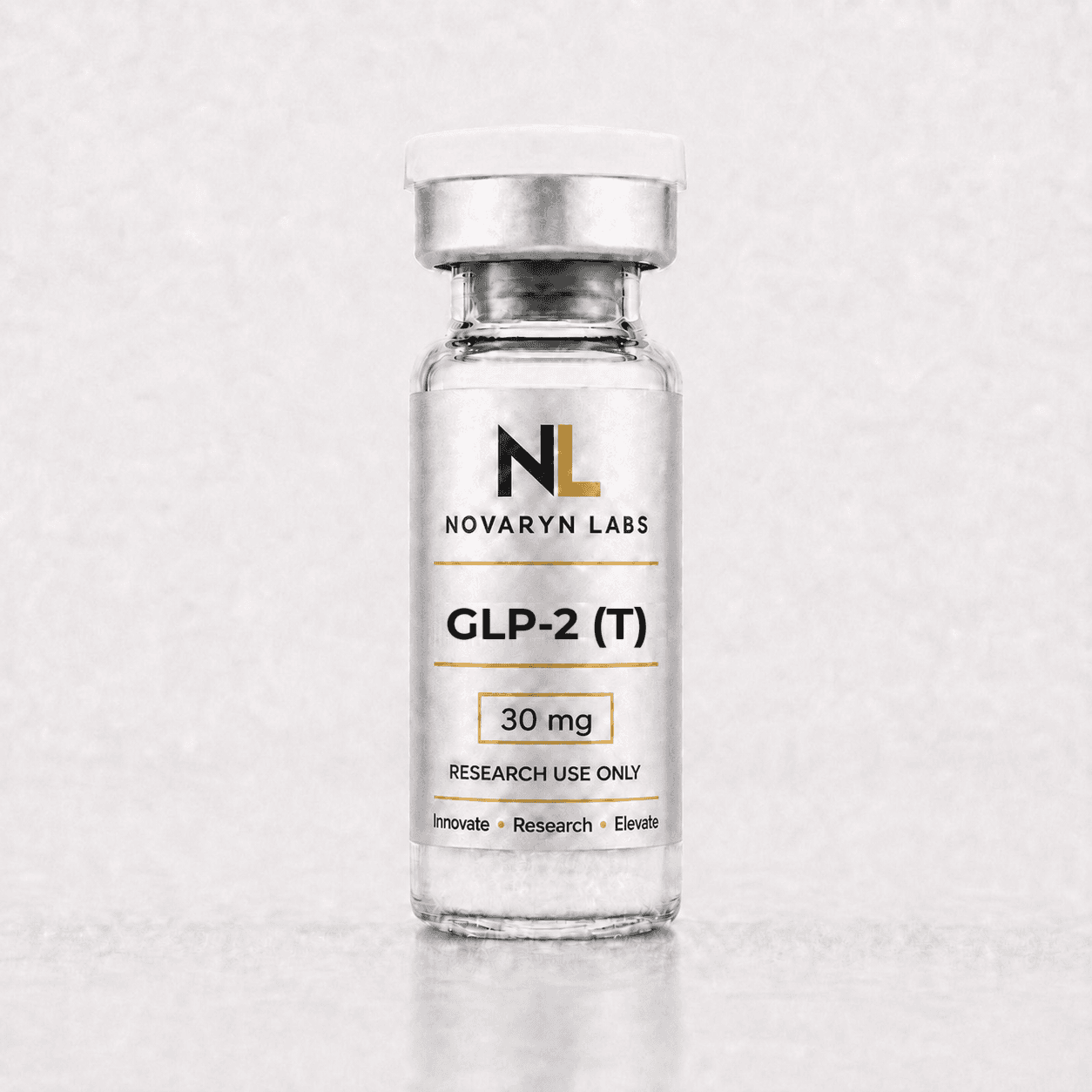
A single peptide can engage more than one receptor, but that does not mean each receptor receives the same signal. Tirzepatide makes this distinction particularly interesting. Its dual activity at the glucose-dependent insulinotropic polypeptide receptor, GIPR, and glucagon-like peptide-1 receptor, GLP-1R, has encouraged researchers to investigate how related hormonal systems interact. The Novaryn Labs catalogue calls the corresponding research material GLP-2 (T). That catalogue label must not be confused with the naturally occurring hormone glucagon-like peptide-2, which has different biology.
This article examines the molecular and experimental questions behind tirzepatide. It separates receptor experiments from clinical findings and separates both from the identity and quality of an individual research batch. These are connected topics, but they require different evidence. A clinical study can establish an outcome for its investigated medicine without validating a separately supplied laboratory material. Likewise, a clean analytical result cannot establish a human outcome.
The scientific interest lies in understanding coordinated metabolic signalling. How does receptor engagement alter cellular responses? Which measurements explain an observed change? And how much of a complex physiological result can be assigned to either receptor? Those questions are more useful than describing a molecule simply as stronger or weaker.
What exactly is tirzepatide?
Tirzepatide is a synthetic peptide engineered to engage two incretin receptors. Incretins are hormones involved in the communication between nutrient intake and pancreatic responses. The catalogue identifies GLP-2 (T) as a 39-amino-acid peptide and provides the tirzepatide CAS identifier. It is a chemically designed molecule, not a mixture of naturally occurring GIP and GLP-1.
Structural research by Sun and colleagues in 2022 examined how tirzepatide interacts with each receptor. Their work supports a molecular explanation for dual recognition: one peptide can accommodate distinct receptor environments. Such structural evidence is valuable because a shared biological effect does not necessarily mean identical molecular contacts. Structural determinants of dual incretin receptor agonism
The research product is also distinct from an authorised medicinal formulation. The catalogue explicitly makes that separation. Product documentation should establish the batch identity, assay scope and suitability for an approved laboratory project, rather than borrowing assurances from a medicine with the same active molecular identity.
How dual receptor signalling works
The central experimental distinction is between binding and response. Binding asks whether a ligand interacts with a receptor. A functional assay asks what happens after that interaction. A molecule can bind two receptors while producing different response profiles at each.
Willard and colleagues reported in 2020 that tirzepatide showed imbalanced activity across GIPR and GLP-1R, with preferential GIPR activity in their experimental systems. They also described signalling bias at GLP-1R, favouring cyclic AMP signalling relative to beta-arrestin recruitment. These observations relate to the assays used and should not be converted into a universal receptor percentage in every tissue. Tirzepatide receptor pharmacology
Cyclic AMP is an intracellular messenger. Beta-arrestins participate in receptor regulation and trafficking. Measuring them separately helps reveal whether two ligands that activate the same receptor actually produce comparable cellular behaviour. This is a practical reason to avoid treating all receptor agonists as interchangeable.
An investigator studying this system might compare a binding measurement with a functional response, then ask whether the relationship changes when receptor expression changes. High receptor expression can make a laboratory system more sensitive, but it can also make that system less representative of a native tissue. The useful question is therefore not merely whether activation occurred, but whether the experimental setting explains the size and duration of the response.
Human islets clarify the GIP contribution
El and colleagues investigated isolated human pancreatic islets in 2023. Their experiments found that GIPR activity was important for tirzepatide-stimulated insulin and glucagon secretion in this preparation. They also identified differences between mouse and human receptor pharmacology. The work supports a direct role for GIPR in human islet responses while warning against assuming that mouse receptor balance reproduces the human system. Human islet study
Insulin secretion is a functional output of pancreatic beta cells, so this study moves beyond a receptor expressed in an artificial cell system. Nevertheless, isolated islets do not reproduce blood flow, whole-body feedback or all donor populations. The investigators did not include islets from donors with type 2 diabetes. These are meaningful limits on extrapolation, not reasons to disregard the cellular result.
Why researchers are interested
Coordinating rather than isolating pathways
Dual agonism offers a way to study whether combined receptor engagement creates an outcome that cannot be predicted from either receptor alone. It also raises an attribution problem. If a whole organism changes its glucose handling or body mass, a single endpoint cannot identify which receptor, tissue or behavioural process was decisive.
A strong experimental design therefore connects levels of observation. Receptor assays can establish activity. Cellular systems can examine downstream responses. Whole-organism studies can measure integrated physiology. None replaces the others, and the most interesting conclusions are those supported across these levels.
Designing informative comparisons
Tirzepatide can inform comparisons between single-receptor and multi-receptor pharmacology. For such work, the comparator should be chosen to answer a defined question. Matching nominal material quantities alone does not necessarily match receptor engagement, exposure or duration of action. An apparent advantage may reflect one of those differences rather than a general property of dual agonism.
This is also why an analytical study and a biological study need different acceptance criteria. A mass spectrum helps establish molecular identity. A receptor response helps establish functional activity under the assay conditions. Agreement between them increases confidence, but neither makes the other redundant.
What published research shows
Human evidence: SURPASS-2
Frías and colleagues reported SURPASS-2 in 2021, an open-label randomised trial involving 1,879 people with type 2 diabetes over 40 weeks. Tirzepatide was compared with semaglutide, and the investigators reported greater reductions in glycated haemoglobin in the tirzepatide groups. Gastrointestinal adverse events were important in interpreting tolerability. This was a clinical comparison in a defined population, not an evaluation of research vials or a direct measurement of each receptor's contribution. SURPASS-2 trial
The trial's value is the controlled comparison. Its limits include the selected population, comparator conditions and finite follow-up. A favourable mean result does not imply that every participant had the same response. The study also cannot answer every mechanistic question that its outcomes generate.
Human obesity comparison: SURMOUNT-5
Aronne and colleagues reported SURMOUNT-5 in 2025, a randomised, open-label phase 3b comparison involving 751 adults with obesity without type 2 diabetes. At 72 weeks, the mean percentage body-weight change was -20.2% with tirzepatide and -13.7% with semaglutide. Gastrointestinal events were the most common adverse events in both groups. SURMOUNT-5
This is direct comparative evidence in a different population from SURPASS-2. The open-label design and selected treatment conditions remain relevant, and the outcome does not reveal exactly how much each receptor contributed. It also does not imply equivalence between clinical formulations and research material.
Molecular evidence: structure and function
The structural and receptor studies cited above provide a different kind of evidence from SURPASS-2. A structure supports an explanation of molecular recognition; a functional assay tests a response in a defined system. Neither is a substitute for a clinical endpoint, while the clinical endpoint alone cannot reveal all the molecular events producing it.
Reading these papers together is more informative than using any one as a universal proof. The resulting research picture is layered: molecular plausibility, experimentally measured signalling and observed clinical effects. The strength of each conclusion depends on which layer directly supports it.
What research communities are discussing
A publicly accessible discussion comparing retatrutide and tirzepatide centres on appetite-related experiences, perceived differences between compounds and unwanted effects. Participants disagree about which felt more effective, and some explicitly question the value of anecdotes. These are accounts of personal experience, not controlled comparisons. Public comparison discussion
The scientifically useful theme is variability. A person comparing two experiences may also have changed diet, activity, other exposures or expectations. Product identity is usually unverified. The thread therefore cannot establish receptor-specific effects or rank research compounds. It does illustrate why subjective appetite, objective metabolic measurements and adverse-event reporting should be considered separately. No personal-use methods from that discussion are reproduced here.
Potential laboratory research applications
Receptor selectivity and response profiling
Researchers can use an appropriately characterised material to investigate GIPR and GLP-1R activity in validated systems. Relevant questions include whether different endpoints agree, whether responses depend on receptor abundance and whether a comparator changes interpretation. These are assay-development questions, not promises about an individual outcome.
Analytical stability and comparability
Peptide identity can be investigated independently from receptor activity. A study comparing material before and after a defined laboratory stress condition might assess whether an altered analytical profile accompanies altered function. The relationship matters because a visually unchanged sample may not retain the same chemical composition.
Translational interpretation
Tirzepatide literature provides a useful example for studying how results move between experimental levels. A well-designed review can map which claims come from cell systems, which come from animal work and which are measured in humans. That mapping prevents a compelling mechanism from being mistaken for direct evidence in an unrelated research setting.
What remains unknown or context dependent?
Dual activity does not reveal the precise contribution of each receptor in every tissue. Assay-derived signalling bias may vary with the measurement system. Clinical averages do not explain all variation between participants, and results from one population cannot automatically be transferred to another.
For catalogue material, published compound research leaves additional questions unanswered: the identity of the supplied lot, its quantitative content, impurities, stability and fitness for the intended laboratory method. These questions should be addressed through documentation and independent analytical work where appropriate. They cannot be settled by a clinical-trial citation.
This article is a selected evidence review, not an exhaustive account of every tirzepatide trial or a continually updated regulatory summary. Further reading should begin with the original studies, their supplementary methods and their stated limitations.
Frequently asked questions
Is GLP-2 (T) the natural hormone GLP-2?
No. Here it is the catalogue label for the tirzepatide-related research material. Natural glucagon-like peptide-2 is a different hormone, so database searches should use the scientific identity rather than the abbreviated label alone.
Is tirzepatide a peptide?
Yes. It is a synthetic peptide. The catalogue describes a 39-amino-acid structure designed for dual incretin-receptor activity.
What does dual agonist mean?
It means that one molecule activates two receptor types. It does not mean that the receptors respond equally or that every downstream signal is identical.
What is biased signalling?
It describes preferential activation of one measured signalling pathway relative to another. The claim needs an explicit assay context and comparator, because different experimental systems can change the apparent pattern.
Has tirzepatide been studied in humans?
Yes. SURPASS-2 is one verified example. Human evidence concerns the investigated clinical material, population and endpoints; it does not validate a separate catalogue batch.
Can a purity result establish receptor activity?
No. Chemical purity and biological activity answer different questions. A functional assay is needed to evaluate response under defined conditions.
Does adding another receptor automatically improve a compound?
No. Additional activity changes the research question and may introduce different effects or trade-offs. A direct comparison needs suitable endpoints, exposure information and appropriate controls.
Where should independent research begin?
Read the original receptor and clinical papers, then compare their test materials with the documentation for the proposed laboratory material. Check identities before comparing outcomes.
Related research and catalogue information
The retatrutide research article examines the additional glucagon-receptor dimension. For batch interpretation, see how to read a certificate of analysis.
The GLP-2 (T) catalogue record provides the corresponding product information and documentation context.
Scientific references
- Sun B and colleagues. Structural determinants of dual incretin receptor agonism by tirzepatide. Proceedings of the National Academy of Sciences, 2022;119:e2116506119. DOI: 10.1073/pnas.2116506119.
- Willard FS and colleagues. Tirzepatide is an imbalanced and biased dual GIP and GLP-1 receptor agonist. JCI Insight, 2020. PMID: 32730231.
- Frías JP and colleagues. Tirzepatide versus Semaglutide Once Weekly in Patients with Type 2 Diabetes. New England Journal of Medicine, 2021;385:503-515. DOI: 10.1056/NEJMoa2107519.
- El K and colleagues. The incretin co-agonist tirzepatide requires GIPR for hormone secretion from human islets. Nature Metabolism, 2023;5:945-954. DOI: 10.1038/s42255-023-00811-0.
- Aronne LJ and colleagues. Tirzepatide as Compared with Semaglutide for the Treatment of Obesity. New England Journal of Medicine, 2025;393:26-36. DOI: 10.1056/nejmoa2416394.
Questions about anything in this guide?
Message the team on WhatsApp for product, batch or documentation questions. We can't give dosing or medical guidance.
For laboratory research use only. Not for human or veterinary consumption. Nothing in this article is medical advice.