

Cellular Biology
Understanding Inflammatory Signalling: Sensors, Cytokines and Resolution
Explore innate immune sensors, NF-kappaB, cytokines and inflammasomes, and learn why a lower inflammatory marker does not explain a whole response.
25 October 2026 · 4 min read · Novaryn Labs
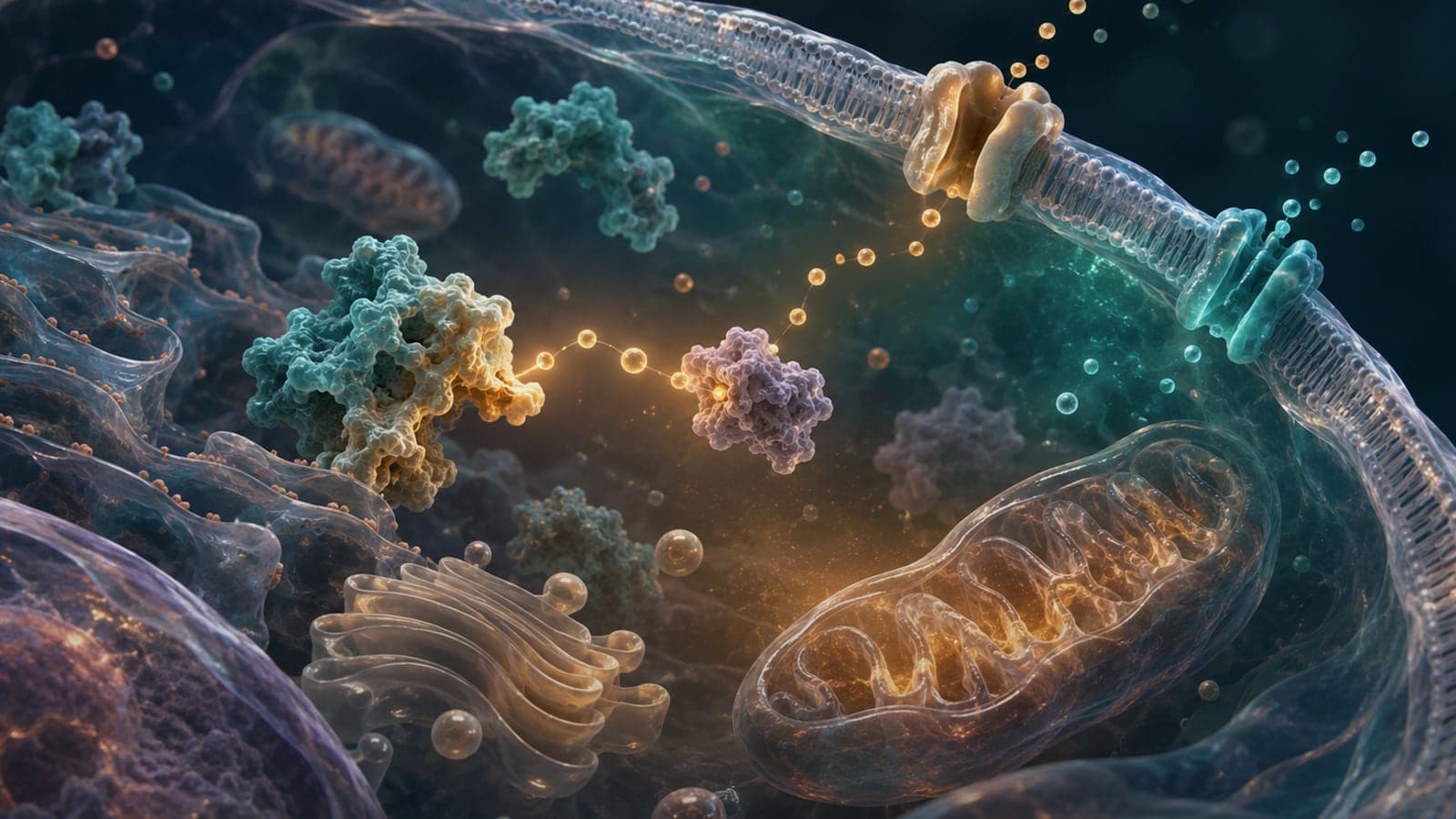
Inflammation is a coordinated biological response to infection, injury and other disturbances. It recruits cells, changes tissue behaviour and helps organise defence and repair. Problems arise when the response is inappropriate, excessive or fails to resolve, but inflammation itself is not simply a malfunction.
Research on inflammatory signalling asks how cells detect a disturbance, transmit that information and regulate the response. These questions are relevant to many experimental peptides, yet a compound should not be called broadly anti-inflammatory on the basis of one isolated marker.
Sensors recognise patterns and damage
Innate immune cells use receptors that respond to molecular patterns associated with microbes or tissue disturbance. Different sensors recognise different inputs and are located at the cell surface, within intracellular compartments or in the cytosol.
Medzhitov, Preston-Hurlburt and Janeway characterised a human Toll-related protein and connected its signalling with NF-kappaB-dependent immune gene expression in experimental cells. The 1997 study helped establish a molecular link between innate recognition and downstream immune activation. Nature.
The broader lesson is that inflammation has identifiable molecular entry points. It is not one undifferentiated signal that can be measured or blocked with a single universal assay.
Adaptor proteins organise the response
Receptors often recruit adaptor proteins that connect recognition to intracellular enzymes. MyD88 is one important adaptor within several Toll-like receptor and interleukin-1 receptor pathways.
Medzhitov and colleagues investigated MyD88 as an adaptor in these signalling systems in 1998. Their work helped explain how different receptor inputs can converge on shared intracellular machinery. Molecular Cell.
Convergence creates an interpretative challenge. A change in a downstream pathway does not uniquely identify which upstream receptor caused it. Specific mechanism claims require experiments that distinguish the alternatives.
NF-kappaB regulates gene expression
NF-kappaB refers to a family of transcription factors involved in immune and stress responses. Activation can alter expression of cytokines, adhesion molecules and other genes, depending on the cell and stimulus.
Researchers may measure nuclear localisation, reporter activity or expression of selected target genes. These are related but different endpoints. A reporter assay can be influenced by general transcriptional suppression, cell viability or direct assay interference.
A decrease in one NF-kappaB-associated signal therefore needs context. Does the cell remain viable? Are other pathways affected? Is the proposed upstream target required? Without these controls, a pathway label can make an observation sound more specific than it is.
Inflammasomes add a processing step
Some inflammatory mediators require more than increased gene expression. Their precursors must be processed into active forms. Inflammasomes are protein complexes that organise activation of inflammatory caspases and related events.
Martinon, Burns and Tschopp described an inflammasome platform involved in inflammatory caspase activation and processing of pro-interleukin-1 beta in 2002. Molecular Cell.
This distinction matters experimentally. Measuring messenger RNA for a cytokine does not establish how much mature cytokine was released. Different assays can capture priming, processing or secretion, and those stages should not be conflated.
Resolution is an active biological process
An effective response changes over time. Recruitment, clearance of damaged material, removal of dying cells and restoration of tissue organisation involve regulated transitions. Simply reducing an early marker does not prove that resolution has improved.
An intervention can also have different consequences depending on timing. A response needed for defence or repair at one stage may contribute to damage if it persists. Research should therefore specify when the compound was studied relative to the initiating event and which part of the response was measured.
This temporal view is especially useful when interpreting tissue-repair studies that include inflammatory endpoints. Less inflammation is not automatically synonymous with better repair.
How experimental compounds are evaluated
A cell study may examine cytokine release after a defined stimulus. An animal model adds immune-cell recruitment and tissue interactions. Human studies investigate different populations and outcomes under formal oversight.
For peptides such as KPV, compound-specific evidence must be kept separate from general knowledge of inflammatory pathways. A plausible connection to NF-kappaB or cytokine biology does not establish a universal effect across all inflammatory conditions.
Reagent quality also matters. Contaminants can stimulate immune cells, and a chemical purity report may not address every relevant contaminant. Material characterisation and assay controls are therefore part of the mechanism, not merely administrative details.
Reading the evidence independently
Identify the initiating stimulus, cell or tissue model, exact endpoint and timing. Ask whether the authors measured cell survival and whether the proposed pathway was tested directly.
A strong conclusion might state that a compound reduced a specified cytokine in a defined model. That is a useful scientific observation. Extending it to broad immune regulation or clinical benefit requires additional evidence.
Frequently asked questions
Is inflammation always harmful?
No. It contributes to defence and repair, while inappropriate or persistent responses can cause problems.
Is NF-kappaB a cytokine?
No. It is a transcription-factor family that helps regulate gene expression.
Does cytokine messenger RNA equal released cytokine?
No. Translation, processing and secretion create additional regulatory steps.
What is an inflammasome?
A protein complex that organises inflammatory caspase activation and related processing events.
Can lower cytokine levels reflect cell damage?
Yes. Reduced viable cell number is one alternative explanation that requires control.
Why test contaminants in relevant assays?
Some contaminants can alter immune responses and confound interpretation of the intended compound.
Related reading
Scientific references
Questions about anything in this guide?
Message the team on WhatsApp for product, batch or documentation questions. We can't give dosing or medical guidance.
For laboratory research use only. Not for human or veterinary consumption. Nothing in this article is medical advice.


