

Hormonal Signalling
Understanding Growth Hormone Signalling: Receptors and Feedback
Follow growth hormone from pituitary release to receptor-associated JAK2 and STAT signalling, with clear distinctions between hormones and secretagogues.
25 October 2026 · 4 min read · Novaryn Labs
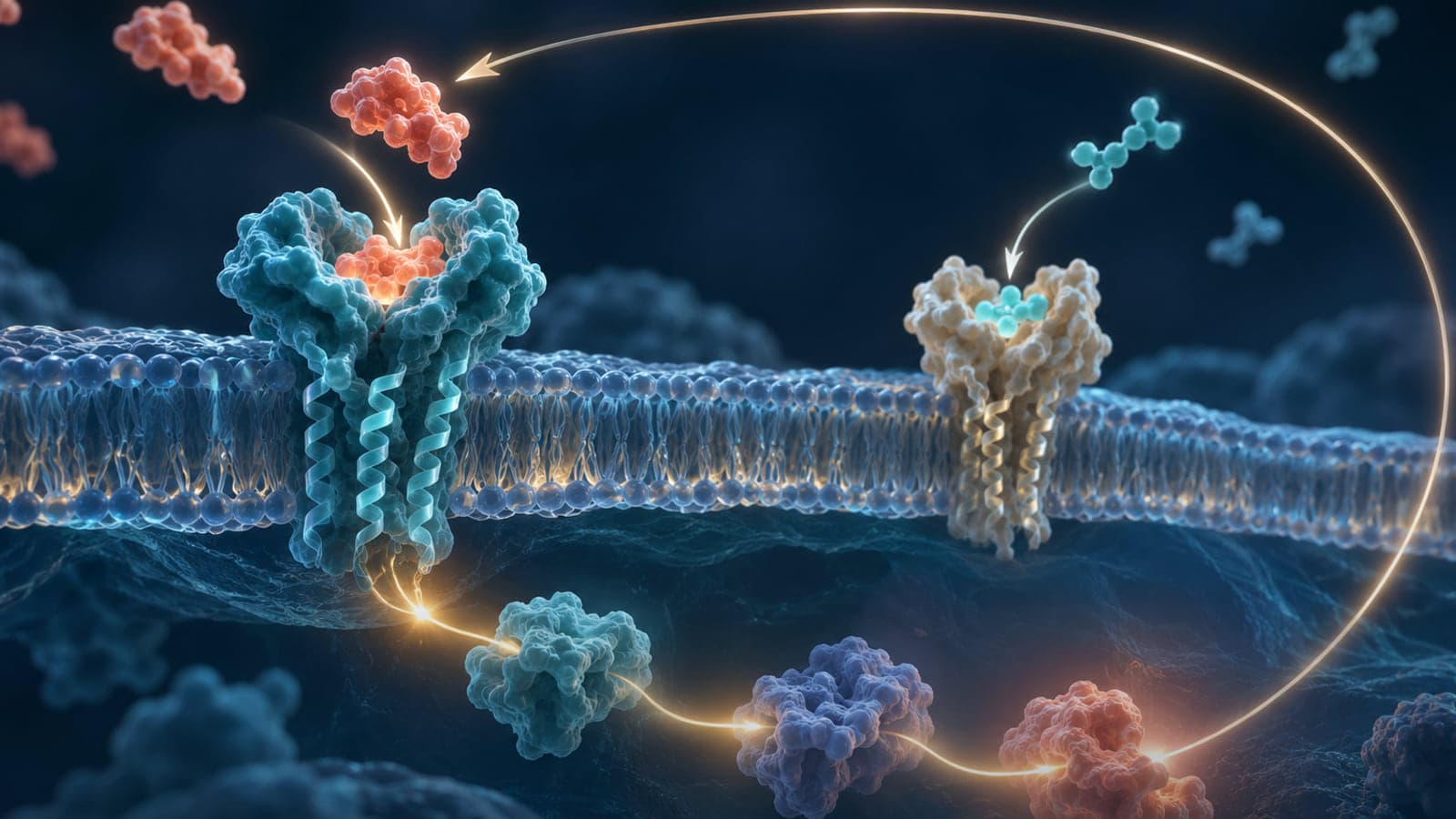
Growth hormone, or GH, is a protein hormone produced by somatotroph cells in the anterior pituitary. Its biology includes growth, nutrient handling and tissue-specific responses. Understanding the system requires separating the control of GH release from the signalling that occurs after GH reaches its receptor.
Those are different experimental questions. A compound that stimulates pituitary secretion is not itself growth hormone, and a change in circulating GH does not directly establish a particular tissue outcome.
The endocrine network upstream of GH
The hypothalamus influences pituitary GH release through growth hormone-releasing hormone and somatostatin, alongside other inputs. Ghrelin and the growth hormone secretagogue receptor provide another route into this regulatory network.
GH secretion is pulsatile rather than constant. Sleep, nutritional state, age and other physiological conditions influence the pattern. A single measurement can therefore be difficult to interpret without its timing and context.
Researchers studying secretion may examine pulse characteristics or integrated measurements. Researchers studying receptor action may instead use cells or tissues exposed to defined conditions. These approaches answer connected but distinct questions.
The growth hormone receptor is not the ghrelin receptor
The GH receptor belongs to the cytokine receptor family. It does not use the same architecture or immediate signalling machinery as the G protein-coupled ghrelin receptor.
GH binding changes the arrangement and activity of the receptor complex, enabling associated signalling proteins to respond. JAK2 is a non-receptor tyrosine kinase that participates in this process. Argetsinger and colleagues identified GH-dependent association and activation involving JAK2 and the GH receptor in 1993. Cell.
This discovery helped explain how an extracellular hormone could initiate intracellular phosphorylation without the receptor itself being a conventional receptor tyrosine kinase.
STAT proteins connect the signal to gene regulation
Signal transducers and activators of transcription, or STAT proteins, can be phosphorylated downstream of receptor-associated kinases. Activated STAT proteins influence transcription of particular genes, depending on the cellular context.
Smit and colleagues used altered GH receptors in experimental cells to investigate the requirements for activation of STAT1, STAT3 and STAT5. The study showed that different receptor regions and signalling interactions contribute to the response. Molecular Endocrinology, 1996.
This is more specific than saying that GH “switches on growth”. The pathway connects molecular interactions to gene regulation, but the final tissue response depends on many additional factors.
IGF-1 is related but distinct
GH influences production of insulin-like growth factor 1, or IGF-1, including endocrine and local tissue processes. IGF-1 acts through its own receptor and signalling pathways. It is not simply another name for GH.
Some GH-associated effects involve IGF-1, while others can arise through direct GH receptor signalling. The relative contribution depends on the tissue and endpoint. A study that measures IGF-1 cannot automatically determine every action of GH, and the reverse is also true.
Feedback helps regulate the system. Signals from downstream hormones and tissues influence hypothalamic and pituitary activity, preventing the pathway from behaving as an unlimited amplifier.
Timing and tissue identity shape the response
A liver cell, muscle cell and adipocyte contain different receptors, signalling proteins and metabolic machinery. The same hormone can therefore produce different patterns of gene expression and function.
The duration and pattern of exposure also matter. A brief signal and sustained stimulation can produce different receptor regulation and feedback. An isolated cell experiment cannot fully recreate the temporal organisation of an endocrine axis.
These considerations explain why a change in one blood marker or phosphorylation measurement should not be described as evidence of general tissue improvement. The claim must remain tied to the measured outcome.
How researchers test the mechanism
Common approaches include receptor-binding studies, phosphorylation assays, gene-expression analysis and genetic alteration of pathway components. Each contributes a different part of the explanation.
A phosphorylation result supports pathway engagement, but functional effects need direct assessment. If the question concerns metabolism, the experiment should measure a relevant metabolic endpoint. If it concerns cell proliferation, cell number and viability need to be distinguished.
Controls also help separate GH receptor activity from signalling through other cytokine receptors that share downstream proteins. JAK2 or STAT activation alone is not a unique fingerprint for GH.
What the evidence does and does not establish
The core GH receptor pathway is supported by extensive molecular research. That foundation does not validate every product described as a GH-related peptide or every proposed outcome associated with the axis.
For secretagogues such as ipamorelin, the relevant starting point is their own receptor pharmacology and compound-specific evidence. Independent readers should follow the chain from the tested molecule to secretion, then from secretion to any measured downstream outcome, without skipping intermediate steps.
Frequently asked questions
Is growth hormone a peptide?
It is a protein hormone composed of an amino-acid chain. Protein and peptide terminology overlap chemically, but GH is generally described as a protein hormone.
Is a secretagogue the same as GH?
No. A secretagogue stimulates release of a substance; it is not necessarily that substance itself.
What does JAK2 do?
It is a kinase associated with several receptor systems, including the GH receptor, and participates in intracellular signalling.
Is STAT activation unique to GH?
No. Other receptors also use STAT pathways.
Why can one GH measurement be misleading?
Secretion varies over time, so sampling context matters.
Does increased IGF-1 establish a specific benefit?
No. It is a biological measurement whose implications depend on the study and endpoint.
Related reading
Scientific references
Questions about anything in this guide?
Message the team on WhatsApp for product, batch or documentation questions. We can't give dosing or medical guidance.
For laboratory research use only. Not for human or veterinary consumption. Nothing in this article is medical advice.
