

Hormonal Signalling
Ipamorelin: Ghrelin Receptor Signalling and Growth Hormone Research
Examine ipamorelin, its ghrelin-receptor pharmacology, growth hormone findings, gastrointestinal trial evidence and unresolved research questions.
25 October 2026 · 9 min read · Novaryn Labs
Introduction
Ipamorelin shows why a receptor can be more scientifically interesting than the label attached to a compound. It is commonly described as a growth hormone secretagogue, meaning a substance that stimulates growth hormone release. Yet its receptor-related biology also led investigators to study gastrointestinal function. The connection is not that growth hormone and gut movement are the same process. It is that one receptor system can participate in several physiological settings.
This synthetic peptide is investigated as a ghrelin-receptor agonist. Its early development focused on the pattern of hormone release produced in experimental models, including comparisons with other secretagogues. Later human work asked a different question about recovery of gastrointestinal function after surgery. Reading those studies together helps distinguish a measured hormonal response from an assumed clinical benefit.
The Novaryn Labs material is supplied for laboratory research. The discussion below concerns molecular identity, experimental reasoning and published findings. It does not treat research material as a medicinal formulation. The most useful starting point is to ask exactly what an experiment measured, rather than interpreting the word secretagogue as a promise about body composition, recovery or ageing.
What exactly is ipamorelin?
Ipamorelin is a synthetic pentapeptide secretagogue, with five residues. The foundational paper gives its sequence as Aib-His-D-2-Nal-D-Phe-Lys-NH2, including non-standard amino-acid features. It is not growth hormone itself, nor is it the naturally occurring hormone ghrelin. The distinction matters because stimulating a receptor that influences hormone release is different from supplying the downstream hormone.
Raun and colleagues published a foundational pharmacological study in 1998 describing ipamorelin as a selective growth hormone secretagogue. Their work compared hormone responses in experimental systems and established a rationale for further investigation. Selectivity in that context refers to the responses measured under the study conditions. It does not mean that every possible biological effect was excluded. Foundational ipamorelin study
Medicinal chemistry work from the same period also investigated related compounds derived from ipamorelin. Ankersen and colleagues tested structure modifications in pituitary-cell and rat systems. This is evidence that small chemical changes can be examined experimentally; it does not make every derivative equivalent to the parent molecule. Ipamorelin-derived peptide research
How does it work?
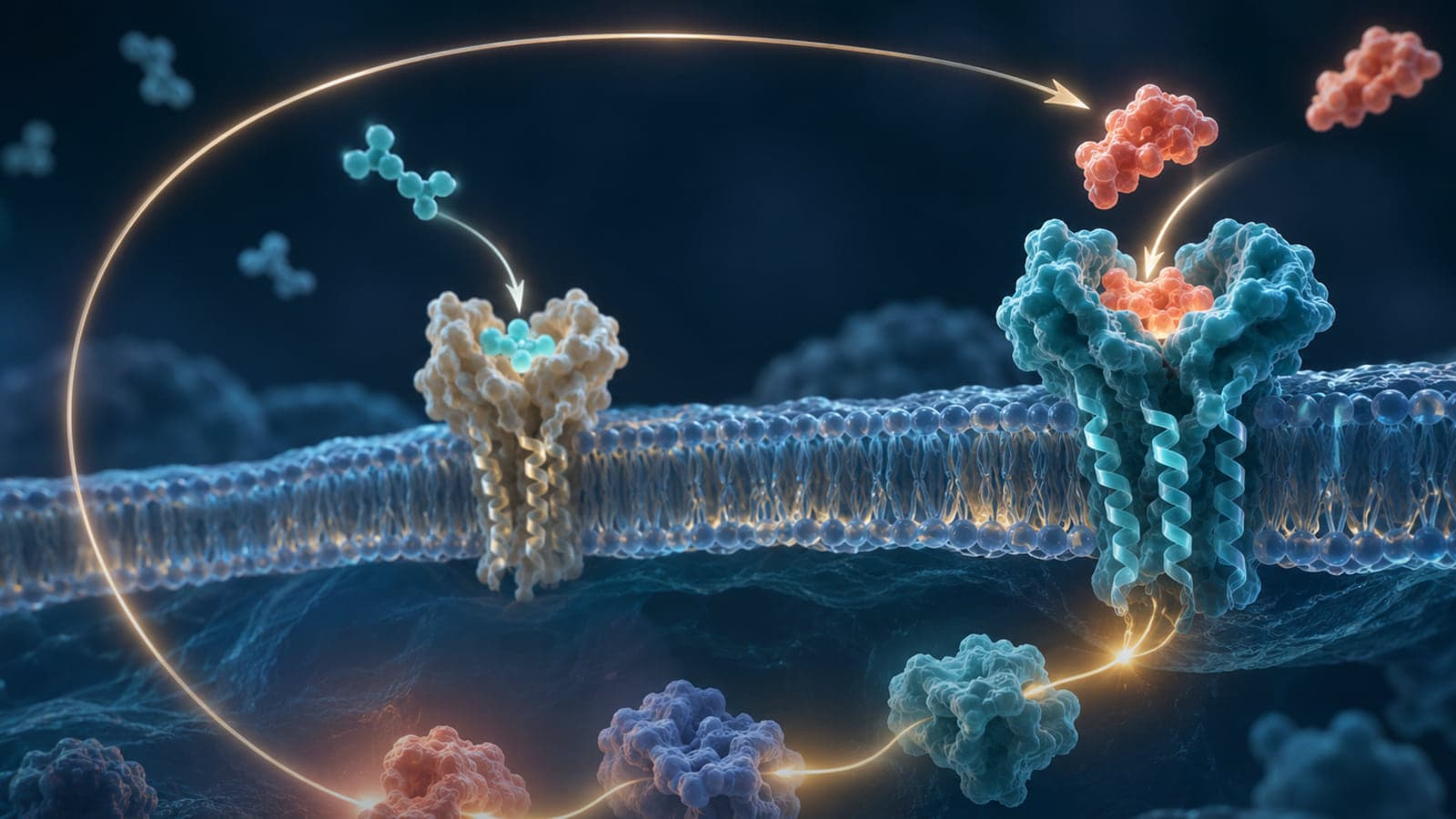
The relevant pharmacological framework is activation of the ghrelin receptor, also called the growth hormone secretagogue receptor. The receptor provides a route through which a ligand can influence signalling and hormone release. The downstream response depends on the cell and physiological context.
A receptor agonist, a secreted hormone and a measured clinical outcome occupy different places in the evidence chain. For ipamorelin, receptor activity can support a mechanism for growth hormone release, but it cannot by itself demonstrate a sustained change in muscle, tissue repair or another complex endpoint. Those conclusions require their own experiments.
This distinction is especially important for pulsatile endocrine systems. A single measurement may capture a peak, a trough or a change in timing rather than a lasting change in overall secretion. An informative endocrine study therefore needs a sampling strategy that matches its question. Otherwise, a real short-lived response can be interpreted too broadly.
The gastrointestinal research programme adds another lesson. A compound described through one endocrine endpoint may be studied in a different organ system because of receptor biology. Evidence for that second application still has to be established independently, rather than borrowed from the first.
GHSR1a, phospholipase C and calcium
The signalling-competent ghrelin receptor is commonly designated GHSR1a. Primary receptor research shows coupling to Gq/11-associated signalling and calcium mobilisation. Phospholipase C generates intracellular messengers that connect receptor activation with calcium-related responses. These are receptor-system findings, not proof that every ligand reproduces every signalling branch identically. Ghrelin-receptor signalling study
Experiments in pig pituitary cells found that blocking phospholipase C or protein kinase C inhibited ghrelin-stimulated growth hormone release. Other signalling interventions also affected the response, illustrating that secretion involves interacting pathways rather than one isolated switch. The ligand in that mechanistic study was ghrelin, so it supplies context for ipamorelin's receptor framework rather than direct ipamorelin-specific confirmation of every step. Somatotrope signalling study
Why researchers investigate ipamorelin
Hormone response specificity
Comparisons between secretagogues can help identify whether different ligands produce similar or distinct hormone-response patterns. The useful output is a defined comparison: which hormones were measured, in which model and over what observation period? A broad adjective such as selective is less informative unless those details accompany it.
Ghrelin-related gastrointestinal research
The ghrelin-receptor framework encouraged investigation of gastrointestinal motility and postoperative ileus. Ileus refers to impaired gut movement after surgery or other physiological disruption. A clinical endpoint such as tolerating a meal is more integrated than a receptor assay, because it reflects the combined influence of surgery, recovery and multiple physiological processes.
Connecting chemistry with function
Ipamorelin and related synthetic compounds offer questions about how structural changes alter experimental responses. These questions can be approached with analytical confirmation, receptor assays and endocrine models. A convincing study keeps the identity of the test compound explicit throughout that chain.
What published studies show
Preclinical pharmacology
The 1998 Raun paper established the experimental selectivity discussion associated with ipamorelin. It examined growth hormone release and compared other hormonal responses in the models studied. That evidence supports describing a particular pharmacological profile. It does not establish unrestricted human safety or efficacy for unrelated outcomes. Raun and colleagues
The companion medicinal chemistry literature investigated derivatives rather than simply repeating the same compound. This is a reminder to check structures when collecting references. A paper can be scientifically relevant to ipamorelin without directly testing the catalogue compound. Ankersen and colleagues
Human gastrointestinal study
Beck and colleagues reported a randomised, double-blind, placebo-controlled phase 2 study in 2014. It enrolled 117 surgical patients, with 114 included in the safety and modified intention-to-treat populations. The key efficacy endpoint concerned the time to tolerating a standardised solid meal. The trial did not find statistically significant differences in its key or secondary efficacy analyses. Postoperative ileus trial
That result deserves clear attention. A plausible receptor mechanism and a numerical difference between groups do not automatically establish clinical efficacy. The study's limited size and varied underlying conditions constrain interpretation, but those limitations do not turn a non-significant finding into a positive result.
What has not been demonstrated here
The sources reviewed for this article do not establish general benefits for athletic performance, healthy ageing or injury recovery. These topics require direct evidence with relevant populations and outcomes. The existence of human research in one clinical setting is not evidence for every setting in which a compound is discussed.
Community discussion and source limits
Public community searches were undertaken for ipamorelin, including peptide and biohacking discussions. The accessible results did not provide a sufficiently clear, independently attributable discussion to support a reliable summary in this review. No community consensus or personal outcome is therefore claimed.
This is an evidence boundary rather than a statement that no discussions exist. Search visibility is uneven, and snippets may omit the context needed to understand a claim. Aggregated descriptions on commercial pages are also not a substitute for the original thread.
Readers encountering community claims can ask a specific set of questions: was ipamorelin the only material involved, was its identity verified, what was actually measured, and was there a comparison? Without that information, an experience cannot establish a receptor-specific effect. Informal reports are best treated as questions to investigate rather than confirmation of a mechanism.
Potential laboratory applications
Endocrine assay development
An appropriately characterised material may be useful in assays designed to examine secretagogue responses. Relevant controls include a suitable baseline, a justified comparator and a method that can distinguish a true biological response from assay interference. The project should define whether it is measuring receptor activity, hormone release or a downstream consequence.
Structure and identity comparisons
Analytical work can compare the intended molecular identity with an authenticated reference. This matters when a literature search includes analogues, salts or related synthetic sequences. A similar name does not establish chemical equivalence, and chemical equivalence does not by itself establish biological equivalence under every condition.
Translational study interpretation
Ipamorelin offers a particularly instructive example of why preclinical interest can coexist with an inconclusive clinical result. A laboratory programme may use that discrepancy to refine questions about model selection, endpoint sensitivity and biological context. It should not simply discard the less favourable evidence.
What remains unknown?
The relationship between short-term endocrine responses and long-term outcomes is not answered by the foundational studies alone. The gastrointestinal trial also leaves questions about whether different models or populations would produce different results. Answering those questions requires new evidence, not reinterpretation of uncertainty as success.
Receptor selectivity should be evaluated in the context of the measurements used. A compound may appear selective when only a narrow set of endpoints is assessed. More complete profiling can reveal additional responses, while differences between experimental systems can alter the apparent pattern.
For a research batch, identity, purity, quantity and functional suitability remain separate questions. Review the lot-specific documentation and the original study methods independently. The certificate of analysis guide explains how to interpret the scope of analytical testing without assuming it answers every biological question.
Frequently asked questions
Is ipamorelin growth hormone?
No. It is a synthetic secretagogue investigated for its ability to stimulate signalling associated with growth hormone release. The downstream hormone and the compound acting upstream are different molecules.
Is it the same as ghrelin?
No. Ghrelin is a naturally occurring hormone. Ipamorelin is a synthetic compound investigated within the ghrelin-receptor pharmacological framework.
What does secretagogue mean?
It means a substance that stimulates secretion. The word identifies a type of biological response, not a guaranteed clinical result.
Does selective mean free of other effects?
No. Selectivity describes comparisons made in a defined experimental context. It cannot rule out every unmeasured response or establish broad safety.
Why was ipamorelin studied in gastrointestinal research?
Ghrelin-receptor stimulation provided a rationale for investigating gut motility. That rationale led to a clinical study, but the cited trial did not show significant efficacy on its main or secondary analyses.
Has ipamorelin been studied in humans?
Yes. The postoperative ileus trial is one verified example. Human investigation should not be confused with proof of efficacy across unrelated applications.
Can growth hormone measurements prove tissue recovery?
No. Hormone measurements and tissue outcomes are different endpoints. A study must directly assess the outcome it claims to explain.
What should be checked before comparing papers?
Check the exact molecule, model, comparator, endpoints and observation period. Papers about related derivatives may inform a question without directly testing ipamorelin itself.
Related research and catalogue information
Kisspeptin research offers a complementary example of an upstream peptide influencing endocrine signalling through a different receptor system. The ipamorelin catalogue record provides product and supporting documentation information.
Scientific references
- Raun K and colleagues. Ipamorelin, the first selective growth hormone secretagogue. European Journal of Endocrinology, 1998;139:552-561. DOI: 10.1530/eje.0.1390552.
- Ankersen M and colleagues. A new series of highly potent growth hormone-releasing peptides derived from ipamorelin. Journal of Medicinal Chemistry, 1998;41:3699-3704. DOI: 10.1021/jm9801962.
- Beck DE and colleagues. Prospective, randomized, controlled, proof-of-concept study of the Ghrelin mimetic ipamorelin for the management of postoperative ileus in bowel resection patients. International Journal of Colorectal Disease, 2014;29:1527-1534. DOI: 10.1007/s00384-014-2030-8.
- Mende F and colleagues. Translating biased signaling in the ghrelin receptor system into differential in vivo functions. Proceedings of the National Academy of Sciences, 2018;115:E10255-E10264. DOI: 10.1073/pnas.1804003115.
- Malagón MM and colleagues. Intracellular signaling mechanisms mediating ghrelin-stimulated growth hormone release in somatotropes. Endocrinology, 2003;144:5372-5380. DOI: 10.1210/en.2003-0723.
Questions about anything in this guide?
Message the team on WhatsApp for product, batch or documentation questions. We can't give dosing or medical guidance.
For laboratory research use only. Not for human or veterinary consumption. Nothing in this article is medical advice.

