
Hormonal Signalling
Kisspeptin-10: KISS1R Signalling and Reproductive Endocrinology
Explore kisspeptin-10, KISS1R and GnRH signalling, human endocrine studies, isoform differences and the limits of reproductive research evidence.
25 October 2026 · 8 min read · Novaryn Labs
Introduction
Reproductive hormones are often discussed at the level of testosterone, oestrogen, luteinising hormone or follicle-stimulating hormone. Kisspeptin research looks further upstream, at signals that help regulate the release of gonadotropin-releasing hormone, GnRH. This makes kisspeptin a particularly informative subject for understanding how the brain and reproductive endocrine system communicate.
The Novaryn Labs catalogue specifically identifies its product as kisspeptin-10. That detail matters. Kisspeptin is a family name, and studies may investigate different molecular forms, including kisspeptin-54. These forms share a receptor-related biological framework, but they are not chemically identical or automatically interchangeable in an experiment.
The scientific interest is substantial: receptor biology, hormone pulsatility, reproductive development and carefully defined clinical investigations all contribute to the field. At the same time, an acute hormone response is not equivalent to a durable reproductive outcome. This article keeps those levels separate and explains why a well-established endogenous signalling pathway does not by itself establish the effects of an independently supplied research material.
What is kisspeptin-10?
Kisspeptin-10 is a ten-amino-acid peptide corresponding to the active terminal region of longer kisspeptin forms. Its receptor is KISS1R, historically called GPR54. A short form can retain receptor activity while differing from a longer form in other experimental characteristics.
George and colleagues described kisspeptin-10 as the minimal kisspeptin sequence with full intrinsic bioactivity in their 2011 human endocrine study. That is a statement about receptor-related biological activity, not proof that every kisspeptin form produces the same exposure or response pattern. Kisspeptin-10 human study
The catalogue's identification of kisspeptin-10 allows the research topic to be defined more precisely than the product's short display name alone. Batch records should still be checked for the exact sequence and analytical identity. A paper labelled simply kisspeptin may need close reading before its results can be assigned to this particular form.
How KISS1R connects to the reproductive axis
From receptor to GnRH
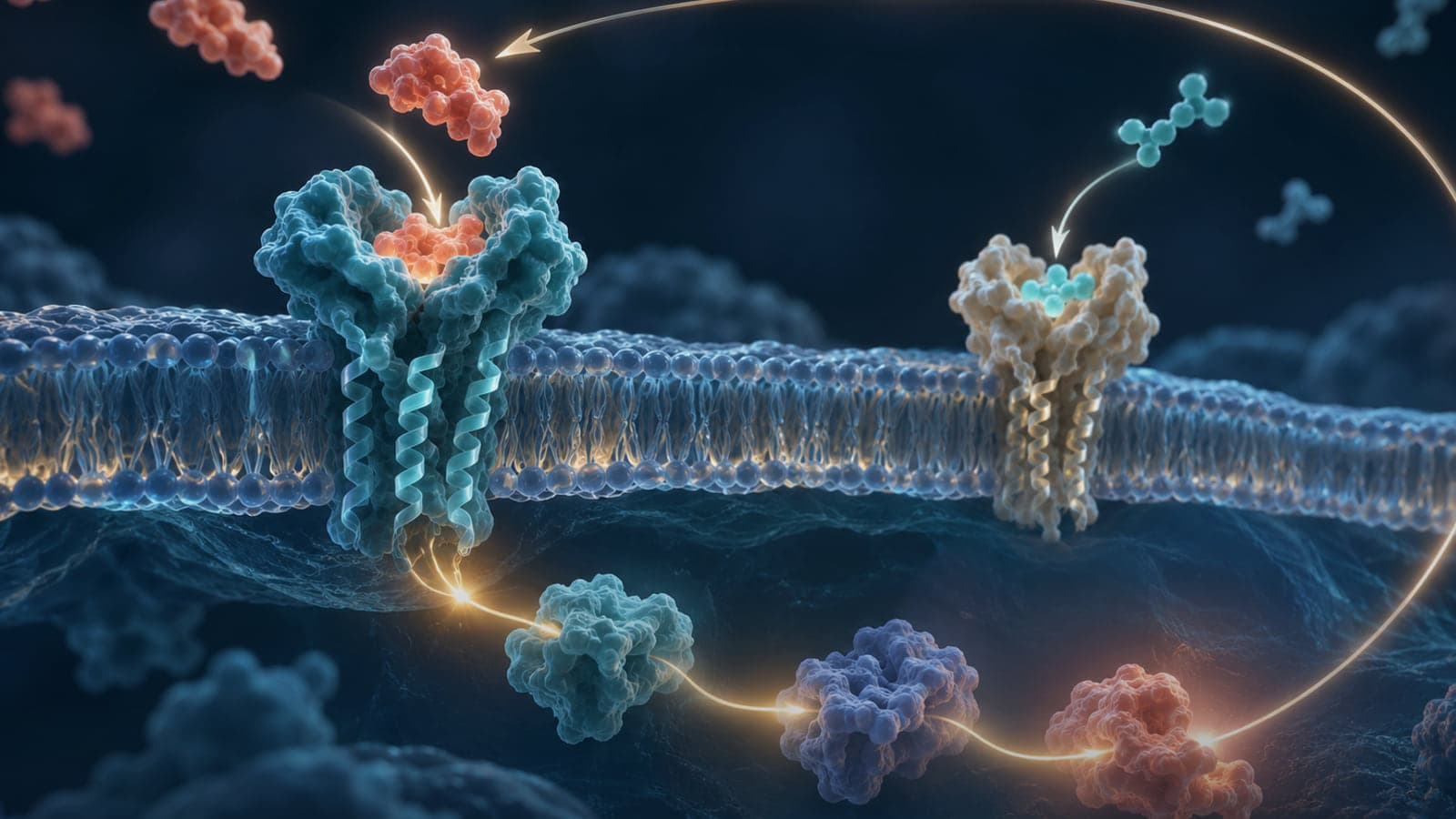
Messager and colleagues investigated the relationship between kisspeptin, GPR54 and GnRH release in 2005. Their work included receptor localisation in mouse GnRH neurons, receptor-deficient animals and direct observations of GnRH-related responses in sheep. It supported the view that kisspeptin signalling can act at the level of GnRH release. Kisspeptin and GnRH study
GnRH then participates in signalling to the pituitary, where gonadotropin secretion forms the next stage of the axis. The main conceptual distinction is between an upstream signal and the downstream hormone measured in blood. A change in luteinising hormone, LH, can provide evidence about the axis without directly revealing every event in the brain.
Intracellular signalling is model dependent
A primary study in baboon pituitary-cell cultures found that kisspeptin-10 could influence LH and growth hormone release. Pharmacological blocking experiments implicated phospholipase C, protein kinase C, MAP kinase and intracellular calcium mobilisation in that system. These are findings from a nonhuman primate cell preparation, not proof of an identical direct pituitary mechanism in every human setting. Primate pituitary study
This distinction helps explain why a simple arrow diagram can be incomplete. An endocrine axis can contain several sites of action, and their importance may change between models. The clearest account identifies which site was actually tested.
Pulses carry information
The timing of hormone release matters as well as the average concentration. A study of pulsatility asks whether the frequency or size of secretory events changes. Taking one sample cannot answer the same question as analysing a sequence of samples designed to detect pulses.
That is why claims that a compound simply raises a hormone are often insufficient. A meaningful endocrine result should identify the observation period, population, measurement and response pattern. The biological system is dynamic rather than a fixed reservoir.
Why scientists investigate kisspeptin
Reproductive neuroendocrinology
Kisspeptin provides a route for studying the relationship between brain signalling and gonadotropin secretion. Researchers can examine whether a response is lost when receptor signalling is interrupted, which is more informative about causation than observing two variables change together.
Differences between molecular forms
Kisspeptin-10 and kisspeptin-54 provide a useful comparison in peptide biology. Sharing a receptor does not erase differences in sequence length or experimental behaviour. A research question about isoform comparability therefore needs matched materials and appropriate endpoints rather than interchangeable terminology.
Clinical translation under controlled conditions
Human studies have investigated endocrine responses and specific reproductive applications. Their importance lies in directly testing defined hypotheses in monitored settings. Their limitations include selected populations and the distinction between a physiological response and a final clinical outcome.
What published research shows
Human kisspeptin-10 physiology
George and colleagues reported acute LH responses and changes in pulse characteristics in small groups of healthy men. The work provides direct human evidence that kisspeptin-10 can influence the reproductive endocrine axis. It does not establish a general strategy for increasing hormones, treating infertility or improving long-term outcomes outside the study. George and colleagues, 2011
The small study groups are particularly important when judging how widely a result applies. A clear physiological signal can be real while uncertainty about population variability and longer-term consequences remains substantial.
Kisspeptin-54 and oocyte maturation
Jayasena and colleagues investigated kisspeptin-54 in a 2014 study involving 53 women undergoing in vitro fertilisation. The study reported oocyte maturation and subsequent reproductive outcomes under a specialised clinical programme. This is evidence about kisspeptin-54 in that setting, not direct evidence for catalogue kisspeptin-10. Kisspeptin-54 study
A later randomised phase 2 study involving 62 women investigated a related clinical question in a population at high risk of ovarian hyperstimulation. Again, the molecular form was kisspeptin-54. The authors identified the need for further comparison with established approaches. 2017 randomised study
What the isoform distinction prevents
It prevents a common evidence error: placing a positive kisspeptin-54 clinical paper beneath a kisspeptin-10 product discussion without explaining the mismatch. The studies are relevant background for the pathway, but their material and clinical context must remain visible.
What communities are discussing
A verified public kisspeptin discussion reports disappointment after comparing personal hormone measurements before and after an uncontrolled period of self-experimentation. The post illustrates interest in testosterone-related outcomes, but it cannot determine whether kisspeptin caused the reported change. Public discussion
Such a comparison lacks verified material identity, an appropriate control and a sampling design capable of characterising endocrine variability. The report therefore neither proves benefit nor proves a consistent adverse hormonal effect. It shows why the scientific question must be more precise than whether a single later value was higher or lower.
No administration details or personal-use methods are reproduced. The useful educational point is that baseline variation, timing and analytical methods can all affect interpretation. Community interest should lead back to controlled physiology studies rather than replace them.
Potential laboratory research applications
Receptor-function studies
Kisspeptin-10 can be considered for validated KISS1R assays investigating receptor-dependent responses. A suitable study distinguishes ligand activity from general effects on cell viability and includes controls that help establish receptor specificity.
Endocrine signal interpretation
The literature provides a foundation for studying how upstream events relate to downstream hormone patterns. In appropriately authorised research, the choice of endpoint should reflect the biological question: receptor activation, secretion, pulse structure and reproductive outcome are separate levels.
Analytical comparison of isoforms
A laboratory can compare identity and analytical characteristics of defined kisspeptin forms. This is useful when reviewing literature because an isoform mismatch can otherwise remain hidden behind a shared name. The research record should make sequence identity explicit.
What remains unknown?
The studies reviewed do not establish reliable long-term outcomes for personal use of kisspeptin-10. Acute endocrine responses do not settle questions about sustained feedback, individual variability or clinical efficacy. Research in healthy men also cannot automatically answer questions about other populations.
The relative contribution of central and peripheral sites of action remains dependent on the experimental question. A direct effect in an isolated pituitary-cell preparation should not be assumed to dominate integrated physiology. Conversely, evidence for an upstream GnRH mechanism does not make every peripheral observation irrelevant.
For catalogue material, published pathway research does not verify the supplied lot. Independent review should include exact molecular form, study population, endpoints and batch documentation. Keeping these records connected is part of reproducibility, as discussed in the batch traceability guide.
Frequently asked questions
Which kisspeptin form does the catalogue identify?
The product description identifies kisspeptin-10. The display name alone is less specific, so the full description and batch documentation matter.
What is KISS1R?
It is the kisspeptin receptor, historically called GPR54. Both names appear in the scientific literature.
Is kisspeptin-10 the same as kisspeptin-54?
No. They are different molecular forms. Shared receptor biology does not justify transferring every experimental result between them.
What is GnRH?
Gonadotropin-releasing hormone is an upstream reproductive endocrine signal. Kisspeptin research examines how its release is regulated and how downstream hormones respond.
Why is pulsatility important?
A hormone can change its release pattern without that change being captured by one measurement. Pulse-focused studies examine timing and secretory structure, not only averages.
Has kisspeptin-10 been studied in humans?
Yes. The 2011 study cited here examined endocrine responses in healthy men. It was a physiological investigation with small groups, not proof of broad long-term benefits.
Do fertility studies validate this research product?
No. Some notable studies used kisspeptin-54 within specialised clinical programmes. Neither those studies nor kisspeptin-10 physiology papers verify an independent catalogue batch.
Can a before-and-after hormone result establish causation?
Not by itself. Timing, natural variation, other exposures and measurement methods can change the result. Controlled study design is needed for a stronger causal interpretation.
Related research and product information
Ipamorelin research explores a different receptor system involved in endocrine secretion. The kisspeptin catalogue record provides the corresponding kisspeptin-10 product information.
Scientific references
- Messager S and colleagues. Kisspeptin directly stimulates gonadotropin-releasing hormone release via G protein-coupled receptor 54. Proceedings of the National Academy of Sciences, 2005;102:1761-1766. DOI: 10.1073/pnas.0409330102.
- George JT and colleagues. Kisspeptin-10 is a potent stimulator of LH and increases pulse frequency in men. Journal of Clinical Endocrinology and Metabolism, 2011;96:E1228-E1236. DOI: 10.1210/jc.2011-0089.
- Luque RM and colleagues. Kisspeptin regulates gonadotroph and somatotroph function in nonhuman primate pituitary via common and distinct signaling mechanisms. Endocrinology, 2011;152:957-966. DOI: 10.1210/en.2010-1142.
- Jayasena CN and colleagues. Kisspeptin-54 triggers egg maturation in women undergoing in vitro fertilization. Journal of Clinical Investigation, 2014;124:3667-3677. DOI: 10.1172/jci75730.
- Abbara A and colleagues. A second dose of kisspeptin-54 improves oocyte maturation in women at high risk of ovarian hyperstimulation syndrome: a Phase 2 randomized controlled trial. Human Reproduction, 2017;32:1915-1924. DOI: 10.1093/humrep/dex253.
Questions about anything in this guide?
Message the team on WhatsApp for product, batch or documentation questions. We can't give dosing or medical guidance.
For laboratory research use only. Not for human or veterinary consumption. Nothing in this article is medical advice.

