

Hormonal Signalling
Understanding the Ghrelin Receptor: Ligands, Basal Activity and Signalling
Explore GHSR1a, ghrelin acylation, constitutive activity and receptor trafficking, with careful distinctions between receptor assays and whole-body physiology.
25 October 2026 · 4 min read · Novaryn Labs
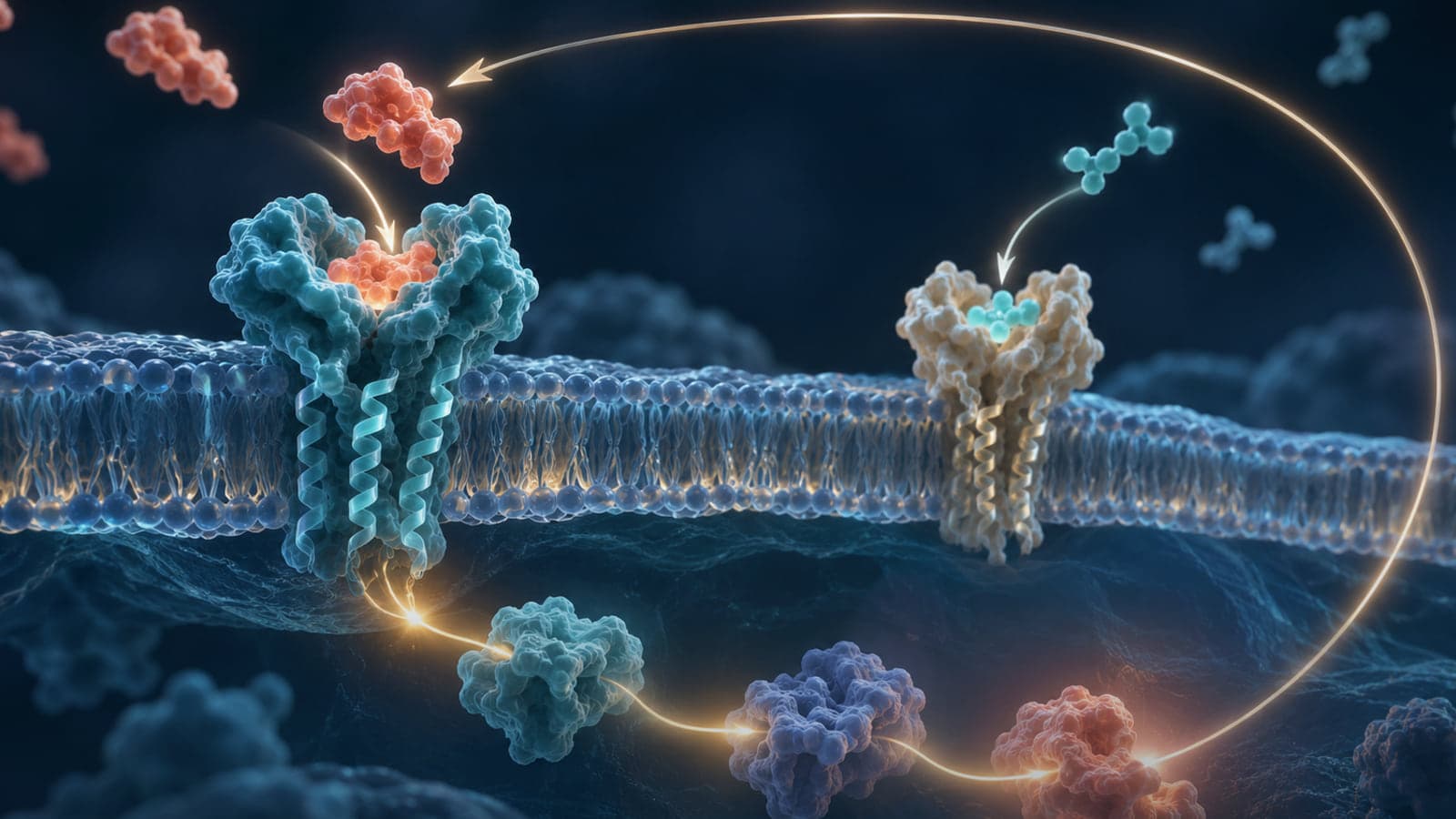
The ghrelin receptor is a useful example of how a receptor can be more complicated than an on-off switch. It responds to the peptide hormone ghrelin, interacts with synthetic ligands and can display signalling activity even without an added ligand in experimental systems.
Its full functional name, growth hormone secretagogue receptor type 1a, is commonly abbreviated GHSR1a. The name reflects its discovery through research on GH-releasing compounds, but the biological questions associated with the receptor extend into appetite, metabolism and neural signalling.
Discovery began with synthetic pharmacology
Howard and colleagues cloned a receptor from pituitary and hypothalamic sources that responded to growth hormone secretagogues. This established a molecular target for compounds whose physiological effects were already being investigated. Science, 1996.
The natural ligand was identified later. Kojima and colleagues isolated ghrelin from stomach material and characterised an acylated peptide with activity at the receptor. Nature, 1999.
The sequence of findings illustrates reverse pharmacology: a receptor and synthetic ligands can lead researchers towards a previously unidentified endogenous signalling molecule.
Acylation is part of ghrelin’s identity
Ghrelin’s fatty-acid modification is important for its recognised activity at GHSR1a. Acylated and des-acyl forms should therefore not be treated as identical experimental materials.
The modification also creates analytical challenges because sample handling can affect the form being measured. A report of total ghrelin and a report of acylated ghrelin may describe different quantities. Comparing them without checking the assay can produce misleading conclusions.
This is a general lesson for peptide biology: a sequence name alone may omit a chemical feature essential to receptor recognition. Exact molecular identity belongs in the interpretation of every study.
G protein signalling is only part of the response
GHSR1a is a class A G protein-coupled receptor. In common experimental settings, its signalling can involve Gq-related pathways, phospholipase C and intracellular calcium-associated responses.
The measured response depends on the cell system and readout. A calcium signal, inositol phosphate measurement and transcriptional reporter provide different views of receptor activity. Their timing and amplification differ.
Receptor expression level also matters. A heavily engineered cell can reveal pharmacological properties but may not reproduce the behaviour of a naturally expressing neuron or pituitary cell. The experimental model should remain visible in the conclusion.
Constitutive activity changes how ligands are classified
Holst and colleagues reported substantial ligand-independent ghrelin receptor signalling in transfected cells. They also identified a ligand that reduced this baseline activity, an inverse agonist. Molecular Endocrinology, 2003.
An agonist increases activity in the relevant assay. A neutral antagonist blocks an agonist without necessarily changing basal signalling. An inverse agonist reduces constitutive activity. These categories explain why “blocks the receptor” can be an incomplete description.
The magnitude of constitutive activity in an expression system should not automatically be assumed to occur identically in every native tissue. The finding establishes a receptor property that must be examined within physiological context.
Receptors move and interact
Receptors can be internalised, recycled or degraded. These trafficking processes influence how long a signal lasts and how a cell responds to subsequent stimulation.
Holliday and colleagues investigated constitutive activity and intracellular trafficking of the ghrelin receptor, showing that baseline behaviour and movement within the cell are connected in experimental systems. Molecular Endocrinology, 2007.
A receptor’s interaction partners can also influence signalling. Such findings help explain why the same ligand may behave differently across cell types. They do not justify assuming that every proposed receptor partnership has the same physiological importance.
From receptor activity to physiology
Ghrelin-associated biology includes GH secretion and feeding-related signalling, but a receptor assay does not directly measure either whole-organism outcome. Tissue distribution, neural circuitry and endocrine feedback intervene between molecular activation and behaviour.
Similarly, a change in circulating hormone concentration does not establish the receptor mechanism responsible. Genetic, pharmacological and physiological approaches are often combined to test the chain of causation.
Research peptides such as ipamorelin are relevant because they provide defined ligands for investigating this system. Their own selectivity, stability and evidence must be assessed rather than inferred entirely from natural ghrelin.
Interpreting the evidence independently
Check which ghrelin form or synthetic ligand was used, which receptor isoform was expressed and which signalling endpoint was measured. Then distinguish direct receptor findings from downstream physiological observations.
This prevents a common error: treating every ghrelin-related study as if it tested the same molecule, target and outcome. The field’s richness comes from those differences, and careful comparisons can reveal how receptor biology actually works.
Frequently asked questions
Is GHSR1a the growth hormone receptor?
No. It is the ghrelin receptor. GH acts through a different receptor family.
Why does ghrelin acylation matter?
It is a key structural feature for recognised activation of GHSR1a.
What is constitutive activity?
Signalling that occurs without an added activating ligand in the measured system.
Is an inverse agonist the same as an antagonist?
Not exactly. An inverse agonist reduces basal activity, while a neutral antagonist primarily blocks agonist action.
Does receptor internalisation always stop signalling?
Not universally. The relationship depends on the receptor and cellular context.
Why avoid transferring all ghrelin findings to synthetic ligands?
Different ligands can have different signalling profiles, selectivity and biological handling.
Related reading
Scientific references
Questions about anything in this guide?
Message the team on WhatsApp for product, batch or documentation questions. We can't give dosing or medical guidance.
For laboratory research use only. Not for human or veterinary consumption. Nothing in this article is medical advice.
