

Cellular Biology
The Biology of Cellular Ageing: Mechanisms, Markers and Limits
Explore senescence, DNA maintenance, proteostasis and mitochondrial changes, while distinguishing ageing markers from demonstrated functional outcomes.
25 October 2026 · 4 min read · Novaryn Labs
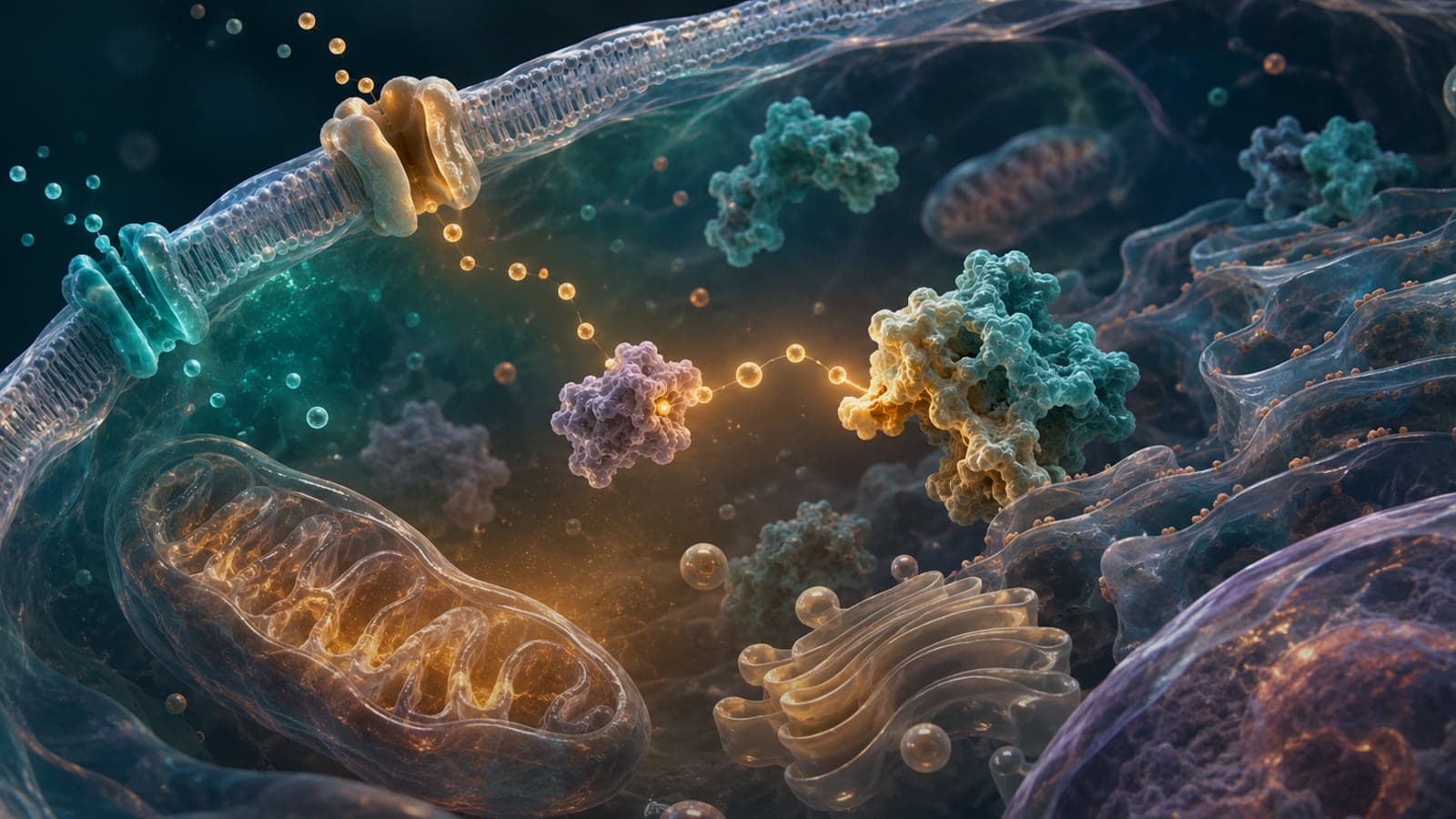
Cellular ageing concerns changes in how cells maintain themselves, respond to stress and interact with their surroundings over time. It overlaps with organismal ageing, but the two are not identical. A change measured in cultured cells does not automatically describe the ageing of an entire person.
The field is compelling because several mechanisms can be studied experimentally. It is also easy to overstate: a compound may alter one marker without restoring tissue function, extending lifespan or improving any human outcome.
Ageing involves interacting systems
Cells must preserve DNA, regulate gene expression, maintain proteins and organelles, and coordinate with neighbouring cells. Failure or adaptation in one system can affect others. DNA damage can alter signalling; mitochondrial changes can affect metabolism; persistent inflammatory signals can reshape tissue behaviour.
This network view is more informative than searching for one universal ageing switch. It also explains why different tissues can age differently and why the same intervention may have different consequences across cell types.
A useful experiment identifies the mechanism being tested and the level of organisation involved: molecule, cell, tissue or organism. Without that distinction, a broad ageing claim can conceal a very narrow endpoint.
Senescence is a cell state, not a synonym for age
Cellular senescence commonly involves stable withdrawal from the cell cycle together with other changes in cell behaviour. Senescent cells can alter their surrounding environment through secreted factors. However, senescence is heterogeneous and can arise through different triggers.
No single marker identifies every senescent cell in every context. Increased expression of one cell-cycle regulator or a positive staining result should be interpreted alongside other evidence. A cell can also stop dividing for reasons other than senescence.
Baker and colleagues used a genetically engineered mouse model to investigate removal of p16Ink4a-positive cells. Their 2011 study provided causal evidence that such cells contributed to selected ageing-associated abnormalities in that model. It was not proof that any commercially described anti-ageing compound reproduces the result. Nature, 2011.
Maintenance and repair create trade-offs
DNA repair, protein quality control and autophagy help cells manage damage. These systems use resources and interact with growth and stress responses. More activity in one pathway is not automatically better in every setting.
For example, a damaged cell’s withdrawal from division can protect tissue from uncontrolled proliferation. Persistent accumulation of altered cells can also impair tissue function. The scientific question is therefore contextual: which cells, which damage and which stage of the response?
This is why an intervention that changes a marker must be evaluated for unintended effects. Removing a protective response can improve one short-term measurement while creating another problem.
Mitochondria and nutrient sensing
Mitochondrial metabolism, redox balance and pathways such as AMPK and mTOR connect resource availability with cellular maintenance. Their involvement in ageing research does not mean that activating or suppressing one pathway uniformly reverses ageing.
A mitochondrial marker can change because cells have altered their metabolism, number or composition. A nutrient-sensing response can be adaptive in one environment and harmful in another. Functional measurements are needed to establish what the molecular change means.
Researchers often combine genetic models with biochemical and physiological assays to separate cause from association. Independent replication across models helps determine whether a mechanism is broadly relevant or specific to one experimental setting.
Biological clocks are measurements, not complete definitions
Some ageing-related tools estimate biological state from patterns such as DNA methylation or gene expression. These can be useful predictors, but a predictor is not automatically a causal mechanism.
Changing a clock-associated measurement does not by itself demonstrate a change in lifespan, tissue resilience or health. The relationship between the marker and the outcome must be validated for the intervention and population being studied.
Similarly, chronological age is an exposure to time, while biological age is an inferred construct. Different clocks may capture different aspects of biology and need not agree in every setting.
What strong ageing research looks like
A persuasive study uses several compatible endpoints and clearly distinguishes lifespan from functional measures. In cell experiments, it should address viability and cell-state changes. In animal work, model selection, sex, age and background conditions influence interpretation.
Longitudinal evidence is especially valuable because ageing unfolds over time. A single snapshot can reveal an association but may not show whether a change causes decline, compensates for it or simply accompanies it.
Independent readers should examine the exact endpoint behind words such as rejuvenation or reversal. If the study measured one marker, the conclusion should remain about that marker until broader evidence exists.
Frequently asked questions
Are senescent cells simply old cells?
No. Senescence is a biological state that can occur in response to several stresses, including in relatively young tissue.
Does one senescence marker prove the state?
Usually multiple features and contextual evidence are needed.
Is lifespan the same as healthspan?
No. Lifespan concerns survival duration; healthspan concerns the period of preserved function, which must be defined and measured.
Can a cell study demonstrate human rejuvenation?
No. It can investigate a cellular mechanism or marker.
Does changing an ageing clock establish a benefit?
Not on its own. The marker’s relationship to meaningful outcomes must be demonstrated.
Why are negative findings useful?
They reveal where a proposed mechanism does not generalise and help refine the biological model.
Related reading
Research models and translation
Scientific references
Questions about anything in this guide?
Message the team on WhatsApp for product, batch or documentation questions. We can't give dosing or medical guidance.
For laboratory research use only. Not for human or veterinary consumption. Nothing in this article is medical advice.


