
Peptide Fundamentals
What Are Peptides? A Complete Beginner’s Guide
Understand peptide bonds, amino-acid sequences, natural signalling and why a peptide’s identity matters more than its research label.
25 October 2026 · 4 min read · Novaryn Labs
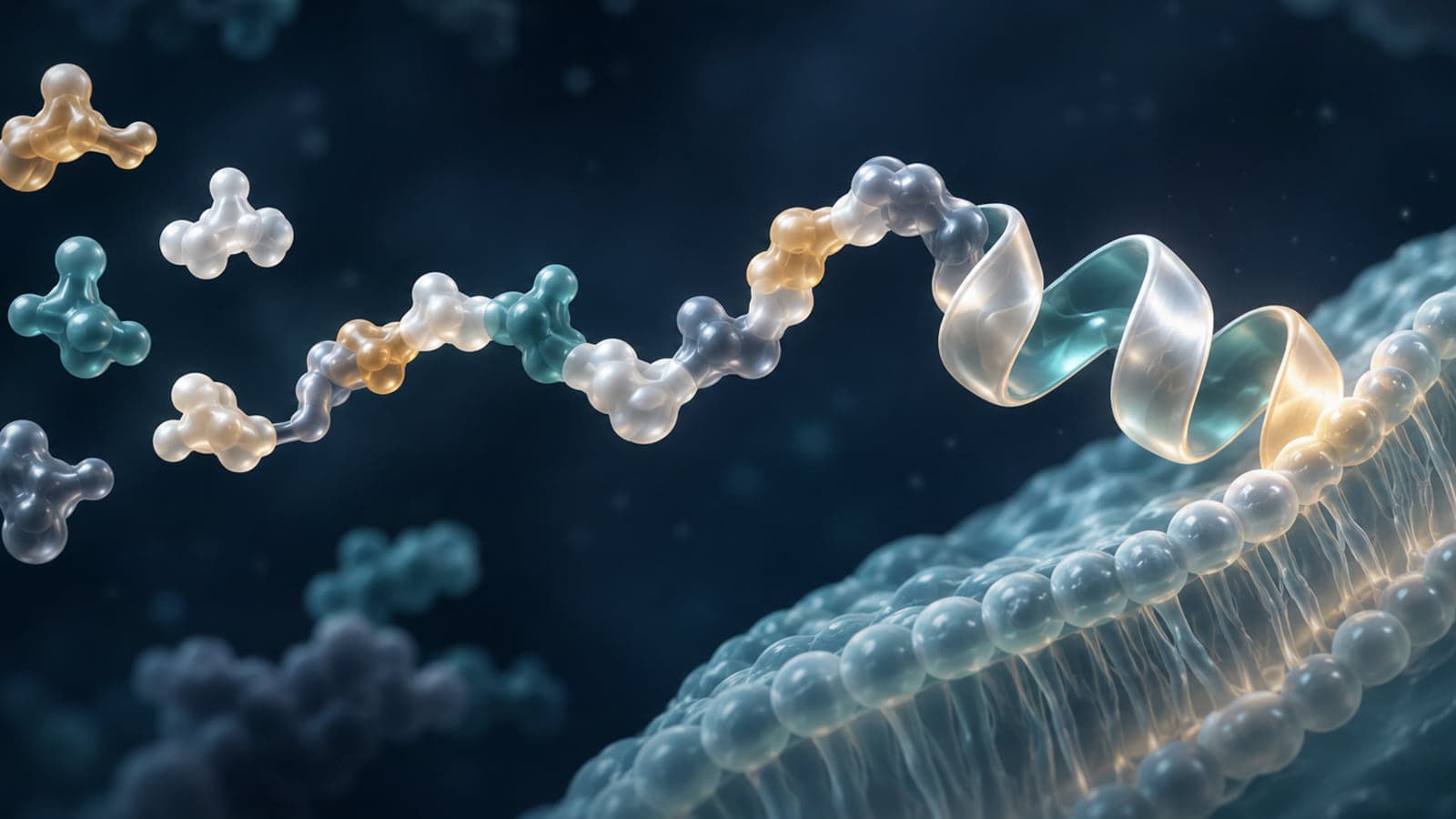
A peptide is a molecule built from amino-acid units joined by peptide bonds. That definition describes its chemistry, not its purpose. Some peptides carry messages between cells, others participate in defence, and many are simply intermediate products of protein breakdown. Calling something a peptide does not tell us whether it has a useful biological effect.
The most helpful starting point is to treat each peptide as a particular molecule. Its sequence, three-dimensional behaviour, modifications and experimental context determine what researchers can learn from it. A shared chemical category does not give every member the same properties.
The bond that defines a peptide
Amino acids contain groups that can join together through an amide linkage, commonly called a peptide bond. After joining, the units in the chain are called amino-acid residues. A dipeptide contains two residues, a tripeptide contains three, and longer chains are often described as polypeptides. The IUPAC definition provides the chemical foundation for these terms.
Most biological peptide sequences are written from the amino terminus, or N-terminus, to the carboxyl terminus, or C-terminus. Direction matters: reversing the order of a sequence produces a different molecule. Letters in a sequence are not interchangeable ingredients in a bag. Their order controls the pattern of chemical groups presented to the surrounding environment.
Why the sequence is only the beginning
The side chains of amino acids differ in charge, size and affinity for water. A sequence rich in hydrophobic residues may behave differently in an aqueous assay from one rich in charged residues. Cysteine residues can participate in disulphide bonds that constrain shape. A cyclic peptide has different structural freedom from a comparable linear chain.
Additional chemical changes can be equally important. Terminal amidation, acetylation, lipid attachment or the inclusion of a D-amino acid can alter recognition, degradation and distribution. Those changes must be included in the identity of the tested material. A familiar abbreviation alone is insufficient to establish equivalence between a published experiment and a research vial.
Ghrelin illustrates the point. Kojima and colleagues identified an acylated peptide in stomach extracts in 1999. Its unusual fatty-acid modification was important for activity at the growth hormone secretagogue receptor. The finding connected molecular structure with receptor function, rather than showing that all short chains of amino acids behave similarly. Original ghrelin study.
Where peptides come from
Cells can produce a larger precursor and then process it into smaller active peptides. Different tissues may process the same precursor differently, creating distinct signals. Other peptides arise from protein degradation or specialised biosynthetic pathways.
Laboratories can also make defined sequences chemically. Solid-phase synthesis, introduced by Merrifield, keeps a growing chain attached to a support while successive amino-acid units are added. Modern synthesis can reproduce a natural sequence or create an analogue with deliberate modifications. Synthetic origin therefore describes how material was made; it does not by itself establish whether the molecule occurs in nature.
How a peptide becomes a useful research tool
A research tool needs more than an interesting name. Researchers establish identity, examine purity and stability, and ask whether the material produces a measurable response in an appropriate system. A receptor experiment may measure binding or a downstream signal. A cell study might examine migration or gene expression. These are different questions with different controls.
One useful comparison is between binding and function. A molecule can bind a receptor without activating it. Another may activate a receptor in an engineered cell line but produce a weaker response in cells with fewer receptors. A third may be degraded before it reaches its target in a more complex model. Each result can be valid within its own setting.
Reading claims without losing the science
Watch for a jump from molecular description to a broad outcome. “Interacts with a pathway involved in repair” is not equivalent to “repairs tissue”. The first can refer to a laboratory measurement; the second requires evidence about organised tissue function. Similarly, finding a peptide naturally in humans does not establish the safety or effect of externally supplied material.
An informative article identifies the exact molecule, the model and the endpoint. It also describes what was not measured. Independent reading is most productive when these three details are recorded together, rather than collecting isolated positive statements from different studies.
Frequently asked questions
Are all peptides hormones?
No. Hormones are one functional group. Peptides can have many other roles, and some have no established signalling function.
Is NAD+ a peptide?
No. NAD+ is a nucleotide-derived coenzyme. Sharing a research catalogue does not make chemically different materials members of the peptide class.
Is a shorter peptide necessarily more selective?
No. Selectivity depends on molecular recognition and the targets tested, rather than chain length alone.
Does a natural sequence guarantee a natural response?
No. Location, timing, processing, concentration within the experimental system and surrounding biology all influence the response.
Can two identical sequences have different laboratory behaviour?
Yes, if their modifications, counterions, aggregation state or impurities differ. Complete analytical characterisation matters.
What should a beginner read next?
Start with receptor signalling and analytical quality. Together they explain how a molecule is identified and how a proposed biological effect is tested.
Related reading
Peptides and proteins compared
Reading a certificate of analysis
Scientific references
Questions about anything in this guide?
Message the team on WhatsApp for product, batch or documentation questions. We can't give dosing or medical guidance.
For laboratory research use only. Not for human or veterinary consumption. Nothing in this article is medical advice.


