

Peptide Fundamentals
Peptides vs Proteins: Understanding Structure, Size and Function
Compare peptides and proteins by sequence, folding and function, and learn why a simple amino-acid cutoff cannot explain their biology.
25 October 2026 · 4 min read · Novaryn Labs
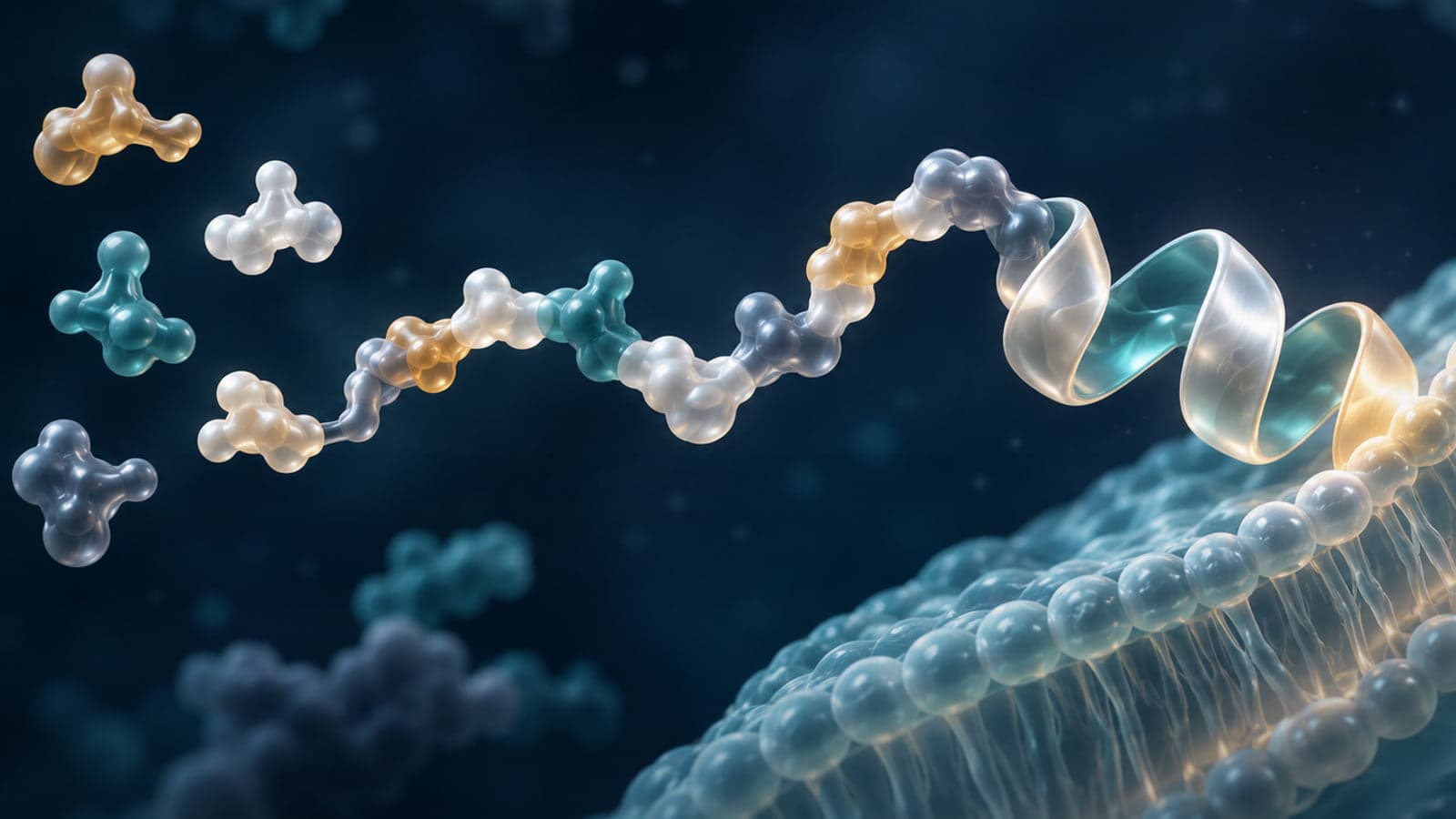
Peptides and proteins belong to the same broad chemical family: chains of amino-acid residues joined through peptide bonds. Their names often emphasise different scales of molecular organisation. Peptide usually suggests a shorter chain, while protein commonly refers to a larger molecule with an organised functional structure.
The boundary is a convention, not a biological wall. A molecule does not acquire an entirely new chemistry when its chain passes a particular length. Understanding the overlap prevents common mistakes when reading studies of fragments, full-length proteins and synthetic analogues.
Length is a useful description, not a complete definition
Amino-acid counts help readers compare molecules, but different fields use peptide and polypeptide somewhat differently. IUPAC defines peptides by their chemical bonds and gives a separate terminology entry for polypeptides. Biological usage also considers structure, processing and historical naming. IUPAC peptide terminology.
A short peptide may be flexible in solution or held in a compact shape by a ring or disulphide bond. A larger protein may contain ordered domains connected by flexible regions. Some proteins are substantially disordered until they interact with a partner. Consequently, “protein means folded, peptide means unstructured” is too simple.
Four levels of structure
Primary structure is the amino-acid sequence. Secondary structure describes local arrangements such as helices and sheets. Tertiary structure refers to the overall three-dimensional arrangement of one chain. Quaternary structure describes the association of multiple chains or subunits.
These levels explain why sequence identity is important but may not be sufficient. A protein can have the correct sequence and still be incorrectly folded or aggregated. A peptide can have the expected mass yet differ in stereochemistry or terminal modification. Analytical methods must match the structural question being asked.
For a multi-chain protein, the pattern of connections between chains can be central to activity. For a small receptor-binding peptide, a few residues and their spatial orientation may dominate recognition. Neither case permits function to be predicted solely from total molecular weight.
Fragments are different experimental materials
When a paper studies a full-length protein, its conclusions cannot automatically be transferred to a fragment. The fragment may omit a binding region, lose a structural constraint or expose a sequence that was hidden in the intact molecule. It may also be degraded or distributed differently.
This distinction is particularly important in thymosin beta-4 research. A short material described as TB-500 and a full-length thymosin beta-4 preparation should not be treated as interchangeable merely because the shorter sequence is derived from the longer one. The exact sequence, modifications and material tested must be checked in the methods section.
The same principle applies in reverse: demonstrating activity for an isolated fragment does not prove that the intact protein presents the same region in the same way. Cleavage can create new biological functions as well as remove old ones.
Manufacturing and characterisation
Shorter chains are often accessible through chemical synthesis. Longer proteins are frequently produced using biological expression systems, although these are tendencies rather than absolute rules. Chemical synthesis allows selected modifications; biological production can support complex folding and processing but introduces its own characterisation requirements.
Merrifield’s original solid-phase work demonstrated a way to assemble a defined short peptide on a solid support. Its significance was methodological: it made systematic sequence construction more practical. It did not eliminate the need to identify the final material or measure impurities. Original 1963 paper.
For both peptides and proteins, identity, purity, content and biological activity are separate attributes. Chromatography can reveal separated components, mass spectrometry can provide molecular information, and a functional assay tests a defined response. No single adjective such as “pure” substitutes for all three.
Why researchers choose one form over another
A short fragment can help identify a recognition motif. A full-length protein can reveal how that motif behaves in its natural structural context. Mutated sequences test the contribution of individual residues. These complementary approaches allow researchers to move from a broad observation towards a more precise mechanism.
However, reducing a system can remove essential biology. A fragment that interacts with purified actin may behave differently in a cell containing many actin-binding proteins. An isolated receptor domain can omit membrane effects. The most useful interpretation states both what the simpler model reveals and what it leaves out.
Frequently asked questions
Is there a universal peptide-to-protein cutoff?
No single numerical boundary works consistently across biological naming conventions. State the actual sequence length whenever it matters.
Are all proteins made from peptides?
Proteins contain peptide-bonded amino-acid chains. In biological synthesis, the chain is assembled by the ribosome rather than necessarily joining pre-existing small peptides.
Is a protein fragment automatically active?
No. Activity must be measured for the particular fragment and endpoint.
Can a peptide have a stable shape?
Yes. Cyclisation, disulphide bonds and interactions with partners can constrain its conformation.
Does a matching mass prove a matching structure?
Not completely. Different arrangements can share a mass, and additional structural evidence may be needed.
How should readers compare two studies?
Record the exact material, production method, structural modifications and assay. Similar names should be treated as a starting point for checking equivalence.
Related reading
Natural and synthetic peptides
Scientific references
-
IUPAC (2025). Compendium of Chemical Terminology, 5th edition: peptides (P04479).
-
IUPAC. Compendium of Chemical Terminology: polypeptides (P04749).
-
ICH (2024). Q2(R2) Validation of Analytical Procedures. FDA final guidance.
Questions about anything in this guide?
Message the team on WhatsApp for product, batch or documentation questions. We can't give dosing or medical guidance.
For laboratory research use only. Not for human or veterinary consumption. Nothing in this article is medical advice.


