
Laboratory Testing
HPLC vs Mass Spectrometry: Complementary Tools for Peptide Testing
Compare chromatographic separation with mass analysis, understand LC-MS and recognise what matching peaks or molecular masses cannot prove.
25 October 2026 · 4 min read · Novaryn Labs
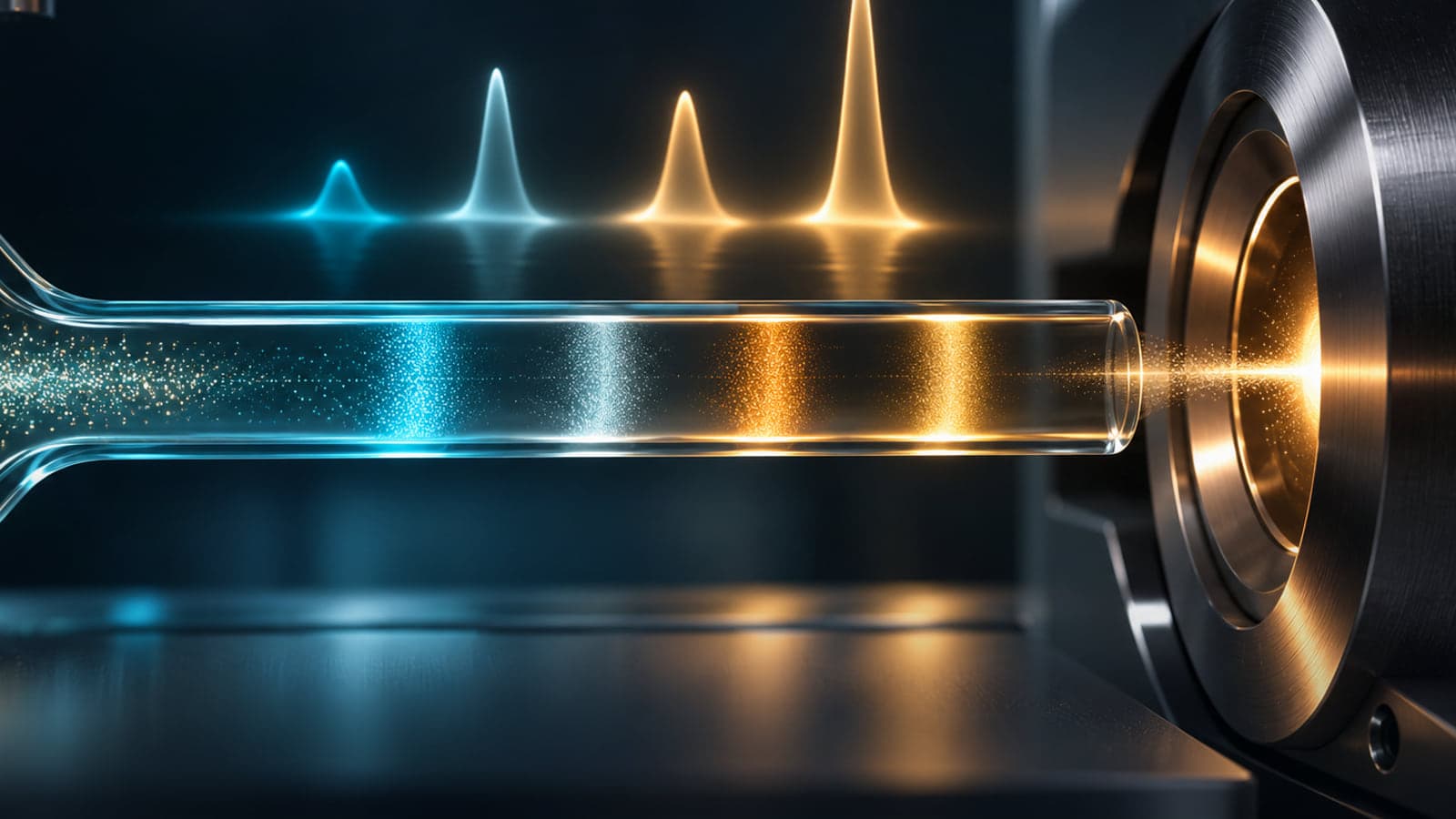
HPLC and mass spectrometry are often listed together on peptide analytical reports because they answer complementary questions. HPLC separates components. Mass spectrometry examines ions and their mass-to-charge relationships. Combining the methods can produce stronger evidence than either alone, but it does not remove the need for careful interpretation.
The most useful comparison is therefore not which technique is better. It is which question each technique can answer and what remains unresolved after both results are available.
HPLC organises a mixture in time
In HPLC, components travel through a column and emerge at different retention times. A detector records their passage. Suitable conditions can separate a target peptide from related synthesis products or degradation products.
The chromatogram reveals the distribution of detected signals across the run. It can support impurity profiling and, with appropriate calibration, quantitative analysis. However, retention time alone is not a unique identity. Different substances can emerge together, and detector response varies with chemical properties.
A main peak can therefore contain more than one component. A minor component can be missed if the method does not separate or detect it adequately. These limitations are properties of the method, not necessarily evidence of poor laboratory practice.
Mass spectrometry examines charged molecules
A mass spectrometer ionises material and measures ions according to mass-to-charge ratio, often written m/z. Peptides can carry more than one charge, so several signals may correspond to the same underlying molecule. Analysts interpret the charge-state pattern to infer molecular information.
Theoretical and observed masses should be compared on a consistent basis. Average molecular mass and monoisotopic mass are different quantities. Adducts, charge states and isotope patterns can affect how a spectrum appears. A credible report explains the interpretation rather than presenting one unexplained number.
An intact mass that agrees with expectation supports identity. It does not necessarily distinguish every sequence isomer, stereochemical variant or structural arrangement with the same mass. Fragmentation analysis and other characterisation can be required when those distinctions matter.
What LC-MS adds
Liquid chromatography coupled to mass spectrometry links separation time with mass information. Analysts can ask which ions appear within a particular chromatographic peak and whether additional species are present.
This can help investigate a suspected impurity or distinguish components that a simple UV trace does not explain. It can also reveal limitations: co-eluting substances may suppress ionisation, and different molecules can produce very different MS responses.
A total-ion chromatogram is not interchangeable with a UV chromatogram. Each represents a different detector response. Likewise, a strong ion signal does not automatically indicate a proportionally large amount of material without an appropriate quantitative method.
Identity, purity and content remain distinct
Consider a hypothetical sample with one dominant HPLC peak and an expected molecular mass. Those findings support a relatively simple chromatographic profile and the presence of material compatible with the expected mass. They do not automatically establish total peptide content, correct stereochemistry, sterility or biological activity.
An appropriate quantitative assay may use reference materials and calibration to estimate content. A biological assay tests function. Separate methods may address water, residual solvents or microbiological attributes. The testing panel should follow the experimental need.
The ICH Q2(R2) guidance explicitly addresses specificity and the use of additional procedures where a single method cannot provide adequate discrimination. This is the analytical rationale for combining techniques with different strengths.
Orthogonal evidence is stronger when truly independent
Two methods are most useful together when their weaknesses differ. Repeating the same separation with a slightly different display does not provide the same independence as adding a structural measurement. Yet even orthogonal methods can share vulnerabilities if both analyse the wrong submitted sample.
Sample identity and traceability therefore sit beneath the instrumental evidence. The laboratory needs to know which batch was tested and how the test sample relates to the material used in the experiment. A sophisticated instrument cannot reconstruct an undocumented chain of custody.
Independent review should examine the whole sequence: material identification, sample handling, method suitability, data interpretation and reporting. This avoids treating instrument names as quality guarantees.
Choosing evidence for the question
For a receptor study, correct molecular identity and relevant impurity control may be central. For degradation research, separation of changing components over time may be the main concern. For quantitative analytical work, calibration and uncertainty become especially important.
The methods are tools within that reasoning. An informative report states what each tool established, why it was suitable and what uncertainty remains. That is more scientifically useful than a broad claim that a sample “passed HPLC and MS”.
Frequently asked questions
Does HPLC identify the molecule?
Retention behaviour can support identification, but structural evidence usually strengthens the conclusion.
Does mass spectrometry measure purity?
It can reveal species and support impurity analysis, but a generic mass spectrum is not automatically a quantitative purity assay.
Why are several masses visible for one peptide?
Different charge states, isotopes or adducts can produce multiple signals from the same molecule.
Can matching mass prove the exact sequence?
Not in every case. Some alternatives share a mass and require additional evidence.
Is LC-MS always quantitative?
No. Quantification requires a suitable method, standards or calibration strategy and performance assessment.
What does orthogonal testing mean?
Using a different measurement principle to examine the same conclusion and reduce dependence on one method’s limitations.
Related reading
Scientific references
Questions about anything in this guide?
Message the team on WhatsApp for product, batch or documentation questions. We can't give dosing or medical guidance.
For laboratory research use only. Not for human or veterinary consumption. Nothing in this article is medical advice.


