

Hormonal Signalling
Kisspeptin and Reproductive Endocrinology: Signals, Pulses and Feedback
Understand kisspeptin, KISS1R, GnRH and reproductive hormone pulses, with evidence from genetics and neural-circuit experiments kept in context.
25 October 2026 · 4 min read · Novaryn Labs
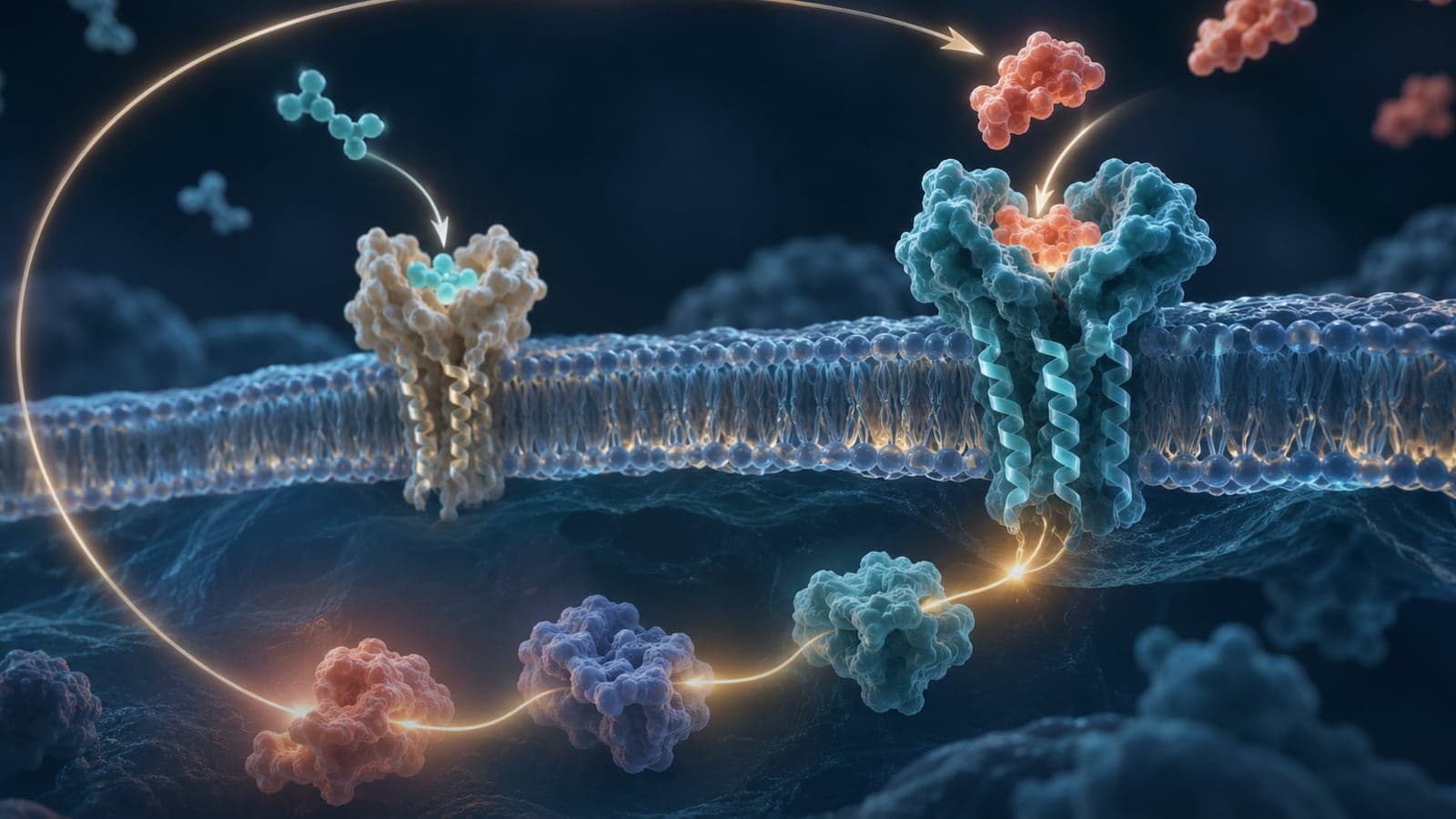
Kisspeptin is part of a signalling system that helps coordinate reproductive endocrine function. Its importance lies not simply in increasing a hormone, but in connecting neural inputs, developmental state and feedback to the timing of hormone release.
The system provides a particularly clear example of how genetics, cell biology and animal experiments can converge on a mechanism. It also shows why identifying a central pathway does not establish a simple external intervention for every reproductive outcome.
The ligand and receptor
The KISS1 gene encodes a precursor that can yield kisspeptin peptides. These peptides interact with the receptor KISS1R, historically called GPR54. Different peptide forms should be identified explicitly when comparing experiments.
KISS1R is a G protein-coupled receptor. Its activation can engage intracellular signalling that influences the activity of relevant neurons, including those associated with gonadotropin-releasing hormone, or GnRH.
A product described simply as kisspeptin therefore needs further molecular specification. A study of one defined fragment cannot automatically establish identical behaviour for every form, analogue or preparation carrying the same family name.
The hypothalamic-pituitary-gonadal axis
GnRH is released from hypothalamic neurons and regulates pituitary secretion of luteinising hormone, LH, and follicle-stimulating hormone, FSH. These hormones act within the reproductive system, which sends feedback signals back to the brain and pituitary.
Kisspeptin operates within this network rather than replacing it. The response depends on the state of GnRH neurons, pituitary responsiveness and feedback from downstream tissues.
This organisation explains why a change in LH is a useful physiological readout but not a complete description of reproductive function. It measures one part of a coordinated axis.
Human genetics established a crucial connection
Seminara and colleagues investigated GPR54 mutations in people with absent or impaired pubertal development and studied a corresponding mouse model. Their work linked loss of receptor function with disruption of normal reproductive endocrine physiology. New England Journal of Medicine, 2003.
The study is important because it combined human genetic observations with experimental approaches. It supported a causal role for the receptor rather than merely finding that two hormone measurements were associated.
However, a loss-of-function phenotype does not establish that increasing signalling beyond its normal pattern is universally beneficial. Necessity and the consequences of externally increasing activity are different questions.
Pulses carry information
Reproductive hormone secretion is organised in time. The frequency and pattern of GnRH-related signalling influence downstream responses. A constant signal and a pulsatile signal need not be interpreted in the same way by the system.
Clarkson and colleagues used neural recording and optogenetic approaches in mice to investigate arcuate kisspeptin neurons. Their work connected coordinated activity in this population with LH pulse generation and tested the relationship experimentally. PNAS, 2017.
This finding supports a specific circuit-level mechanism in mice. It should not be converted into a human administration schedule or a claim that a research preparation reproduces the natural pulse generator.
Feedback and biological context
Sex-steroid feedback helps regulate the reproductive axis, and the system changes across development and physiological states. Nutritional and stress-related inputs can also influence reproductive neuroendocrine function.
The same molecular stimulus can therefore produce different responses depending on the model and baseline state. Studies should identify sex, developmental stage and relevant endocrine conditions rather than treating participants or animals as interchangeable.
Neural circuitry also introduces species differences. A receptor can have a conserved role while the organisation or regulation of specific neuronal populations differs. Translation requires evidence rather than assumption.
What experiments can establish
Receptor assays examine ligand activity and signalling. Genetic studies test whether components are required. Neural recording links cell activity with hormone patterns, while targeted manipulation can strengthen causal inference. Human physiological studies can investigate defined responses under formal research oversight.
Each method has boundaries. A hormone response does not establish fertility outcomes, and an association between neural activity and secretion needs additional experiments to support causality. An isolated receptor assay cannot reproduce feedback across the entire endocrine axis.
Researchers can build a stronger explanation by combining these approaches while keeping their conclusions at the appropriate level.
Reading kisspeptin claims carefully
First identify the exact peptide and receptor terminology. Next determine whether the paper addresses puberty, pulse generation, hormone secretion or another endpoint. Finally, ask whether the conclusion concerns normal physiology, a particular model or a clinical population.
Independent reading is especially valuable when broad language such as reproductive support replaces specific measurements. The actual evidence may be scientifically fascinating while remaining much narrower than that phrase suggests.
Frequently asked questions
Is KISS1R the same as GPR54?
Yes. GPR54 is the historical name commonly used in early studies of the kisspeptin receptor.
Is kisspeptin the same as GnRH?
No. They are different signalling peptides within a connected endocrine network.
Why do hormone pulses matter?
Timing can influence how downstream cells interpret a signal, not just how much hormone is present overall.
Does an LH response prove improved fertility?
No. LH is one physiological endpoint; reproductive outcomes require separate evidence.
What did the 2003 genetic study show?
It linked impaired receptor function with disrupted pubertal and reproductive endocrine physiology in the studied systems.
Can all kisspeptin forms be treated as equivalent?
No. The exact sequence, modifications and preparation should be checked.
Related reading
Kisspeptin research material review
Scientific references
Questions about anything in this guide?
Message the team on WhatsApp for product, batch or documentation questions. We can't give dosing or medical guidance.
For laboratory research use only. Not for human or veterinary consumption. Nothing in this article is medical advice.

