
Peptide Fundamentals
Understanding the Stages of Peptide Research
Follow peptide research from discovery and target validation to controlled studies, with clear distinctions between promising signals and established evidence.
25 October 2026 · 4 min read · Novaryn Labs
Peptide research develops through a series of questions rather than a ladder on which every compound inevitably advances. What is the molecule? What does it interact with? Does that interaction matter in a biological system? Can the findings be reproduced? Some peptides remain valuable laboratory tools without ever becoming clinical candidates.
Recognising the stage of a study makes its findings more useful. A receptor experiment can be strong evidence about receptor activity while providing little information about long-term outcomes. A small human study can answer a focused physiological question without establishing broad effectiveness.
Discovery: finding a molecule or a useful signal
Discovery may begin with a natural extract, a genetic observation, a receptor with an unknown ligand or a screen of synthetic compounds. The immediate challenge is to connect a reproducible activity with a defined molecular identity.
The discovery of ghrelin provides a clear example. Researchers isolated a stomach-derived ligand for the growth hormone secretagogue receptor and identified a specific acylated peptide. This linked a previously studied receptor system to an endogenous molecule. It did not, by itself, answer every later question about appetite, metabolism or clinical use. Kojima et al., 1999.
Target validation: does the proposed mechanism hold up?
A plausible target becomes more convincing when several methods agree. Researchers can measure binding, alter the target genetically and assess whether the expected cellular response changes. Rescue experiments, in which function is restored after a targeted disruption, can strengthen a causal interpretation.
This stage also tests selectivity. If a compound affects several unrelated pathways, the observed endpoint may not be attributable to the proposed target. Testing only one receptor cannot establish that all other receptors are unaffected. Negative findings and alternative explanations are part of validation, not distractions from it.
Preclinical work: adding biological complexity
Biochemical assays simplify a problem. Cell cultures add membrane barriers and intracellular networks. Organoids and tissue preparations retain further aspects of organisation. Animal models allow researchers to examine interactions among organs and biological systems.
Each model makes trade-offs. An engineered cell line can isolate one receptor but express it at an unusual level. A rodent model can reveal integrated physiology but differ from humans in metabolism and receptor distribution. A human-derived organoid can retain relevant cellular features without reproducing circulation, immune interactions or whole-organism behaviour.
The best model is the one suited to the question, not automatically the most complex one. A mechanistic claim may require a simple system first and a more integrated system later.
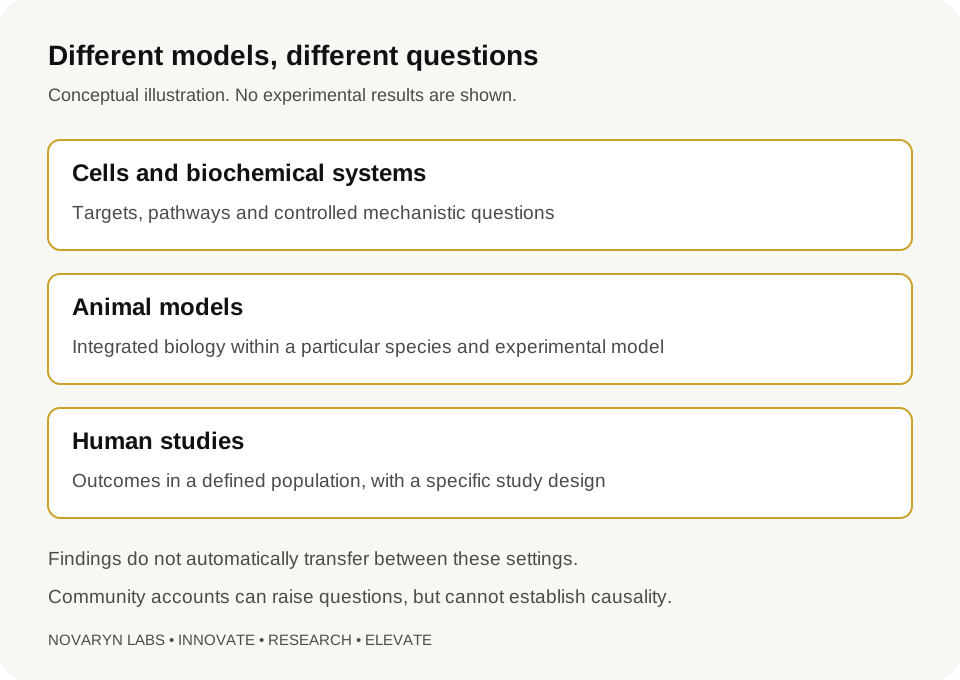
This conceptual illustration compares research models. It does not display experimental results.
Clinical research: distinct phases and objectives
When a candidate enters formal clinical development, early studies typically focus on tolerability, pharmacology and characterisation of exposure. Later studies examine defined outcomes in selected populations and compare the candidate with an appropriate control. Confirmatory work seeks sufficiently reliable evidence for a specific proposed use.
The FDA development framework describes discovery, preclinical work, clinical research, regulatory review and post-market monitoring. This is an overview of a US process, not a claim that every peptide follows identical steps or has the same status elsewhere.
Trial phase is informative but insufficient. Sample selection, allocation, blinding, follow-up and outcome definitions still matter. A later-phase study with an unsuitable endpoint does not answer a different question merely because its phase number is higher.
Replication and translation are separate achievements
Replication asks whether a finding can be observed again using new data. Translation asks whether knowledge remains useful in another setting, such as moving from a model to human physiology. A reproducible rodent finding may fail to translate because the underlying biology differs.
Manufacturing is another part of translation. A candidate must be consistently characterised, and changes in production may require evidence that relevant properties are maintained. Biological plausibility cannot compensate for uncertainty about the material being tested.
The National Academies report on reproducibility and replicability distinguishes computational reproduction from independent replication and discusses uncertainty. Those distinctions help explain why one successful study is a starting point for confidence rather than its endpoint.
Why projects stop or change direction
A programme may encounter insufficient selectivity, instability, inconsistent effects or an unfavourable balance of findings. It may also discover that the original hypothesis was incomplete. Such results refine scientific understanding, particularly when methods and data are reported transparently.
For readers, the practical question is not whether a compound is “promising” in the abstract. Ask which uncertainties have been reduced and which remain. Independent assessment should follow the exact molecule and research question rather than assuming that progress elsewhere in a peptide family applies equally to every member.
Frequently asked questions
Does a cell study count as evidence?
Yes, for questions the model can address. Its limits should be stated alongside its findings.
Do animal results predict human outcomes?
Sometimes they inform hypotheses, but prediction is imperfect and must be tested.
Does a registered trial mean a result exists?
No. Registration records a study plan or status. Results require separate examination.
Is phase 1 proof of effectiveness?
Usually it is primarily early characterisation. Any exploratory outcome should be interpreted in that context.
What does independent replication add?
It tests whether a result survives new data collection and reduces dependence on one laboratory or dataset.
Can a discontinued candidate still matter scientifically?
Yes. It may reveal a mechanism, expose a limitation or guide better experimental tools.
Related reading
Laboratory, animal and human studies
Scientific references
-
National Academies (2019): reproducibility and replicability
-
NIH. Enhancing Reproducibility through Rigor and Transparency.
Questions about anything in this guide?
Message the team on WhatsApp for product, batch or documentation questions. We can't give dosing or medical guidance.
For laboratory research use only. Not for human or veterinary consumption. Nothing in this article is medical advice.


